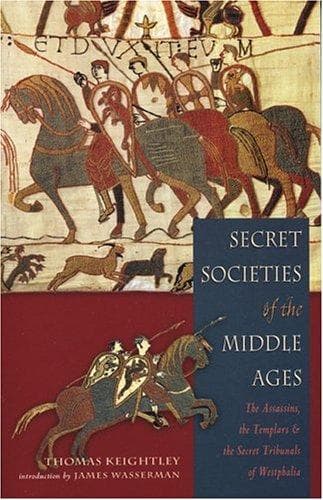
Secret Societies of the Middle AgesKeightley, Thomas
History
Secret Societies of the Middle Ages
Keightley, Thomas
Secret societies
To narrate the various exploits of the knights of the Temple, would be
to write the history of the Crusades; for, from the time that the order
acquired strength and consistency, no action with the Infidels ever was
fought in which the chivalry of the Temple did not bear a distinguished
part. Their war-cry was ever heard in the thickest of the fray, and
rarely was _Bauseant_ seen to waver or give back in the conflict. The
knights of St. John fought with emulative valour; the example of the
rival orders stimulated all parts of the Christian army; and to this
influence may be, in great measure, ascribed many of the most wonderful
triumphs of the Cross during the twelfth century.
In the year 1147, when Pope Eugenius III. came to Paris to arrange the
proposed crusade with Louis VII., both the pope and the king honoured
with their presence a general chapter of the order of the Temple, which
was holden at that place. It was probably on this occasion that the
supreme pontiff conferred on the order the important privilege of having
mass said once a year in places lying under interdict. The newly-elected
Master of the Temple, Eberhard de Bar, and 130 knights, accompanied the
king on his march for the Holy Land; and their valour and their skill
greatly contributed towards the preservation of the crusading army in
their unfortunate march through Lesser Asia. The siege of Damascus,
which was undertaken after the arrival of the French and German kings in
the Holy Land, miscarried, as is well known, through treachery. The
traitors were doubtless the _Pullani_, as the Latins of Syria were
called, who were at this time capable of every thing that is bad. Some
writers most unjustly charge the Templars with this guilt; but those who
are the best informed on the subject make no accusation against them.
The charge, however, while it shows the power and consideration of the
Templars at that time, may be considered to prove also that they had
degenerated somewhat from their original virtue; for otherwise it could
never have been made.
Public-domain text, read in full here on John Shaqi.
Reviews
Reviews
No reviews yet
Be the first to share your thoughts on this work.
Elsewhere in the archive
Join the Discussion
Join the discussion
Sign in to leave a comment or review.
Sign InorCreate an account