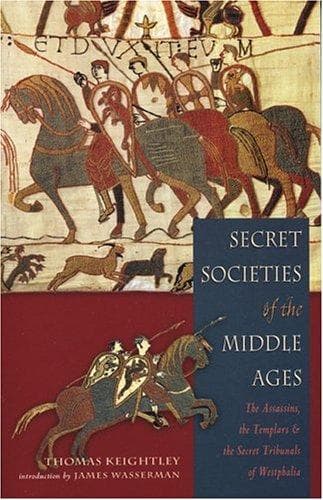
Secret Societies of the Middle AgesKeightley, Thomas
History
Secret Societies of the Middle Ages
Keightley, Thomas
Secret societies
Yet the two orders of religious chivalry had not derogated from their
original valour, and the last days of Jerusalem were illumined by some
noble feats of prowess. On the 1st of May, 1187, when Malek-el-Afdal,
the son of Saladin, was returning from an expedition into the Holy Land,
which he had undertaken with the consent of the Count of Tripolis,
regent of the kingdom, the Masters of the Temple and of the Hospital,
having collected about 140 knights and 500 footmen, met the Moslems, who
were 7,000 in number, at the celebrated brook Kishon. They immediately
charged them with the utmost impetuosity; the Turks, according to
custom, turned and fled; the Christian knights pursued, leaving their
infantry unprotected. Suddenly a large body of the Turks emerged from a
valley, and fell on and slaughtered the footmen. Their cries brought
back the knights to their aid, but, impeded by the narrowness of the
ground, they could neither lay their lances in rest nor run their horses
against the enemy, and all fell beneath the weapons of the Turks, with
the exception of the Master of the Temple and three of his knights, who
were saved by the fleetness of their horses. The Master of the Hospital
was among the slain. In this unfortunate fight, James De Mailly, the
marshal of the Templars, and a Hospitaller, named Henry, especially
distinguished themselves. After all their brave companions had been
slain around them, they still maintained the conflict; the Turks, filled
with admiration of their valour, repeatedly offered them quarter, but in
vain; and they fell at last, overwhelmed with darts flung from a
distance, no one venturing to approach them. The historian, Vinisauf,
tells us that De Mailly was mounted on a white horse, which, joined with
his relucent arms and white mantle, made him appear to the infidels to
be St. George, and they exulted greatly in having slain the tutelar
saint of the Christians. He adds, what is not an unlikely circumstance,
that the Turks covered his body with dust, which they afterwards
powdered on their heads, thinking thereby to acquire some portion of his
valour.
Public-domain text, read in full here on John Shaqi.
Reviews
Reviews
No reviews yet
Be the first to share your thoughts on this work.
Elsewhere in the archive
Join the Discussion
Join the discussion
Sign in to leave a comment or review.
Sign InorCreate an account