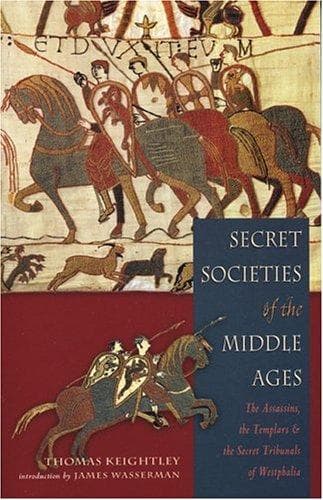
Secret Societies of the Middle AgesKeightley, Thomas
History
Secret Societies of the Middle Ages
Keightley, Thomas
Secret societies
At the fatal battle of Hittin, where 30,000 Christians lost their lives,
where the king and all his princes became captives, and where the Latin
power in the East was broken for ever, the Master of the Temple, Gerard
of Ridefort, and several of his knights and those of the Hospital, were
among the captives. Saladin, who bore a particular hatred to the
spiritual knights, would spare them on no condition but that of their
renouncing their faith. To a man they gallantly refused; and, with the
exception of the Master, the heads of all were struck off. Many who
belonged not to the orders, smit with desire for the glory of martyrdom,
cast the mantles of Templars around them, and went cheerfully to death
as such. One Templar, named Nicolaus, evinced such joy and impatience
for this glorious fate, that, according to the ideas of those times,
heaven was believed to testify its approbation by a visible sign, and
during three nights a celestial light illumined the unburied corpse of
the Christian martyr.
It was indeed rare for a Templar to renounce his faith: prejudice, or
honour, we may style it, or a better principle, always kept him steady
in it, whatever the irregularities of his life might be. We recollect
but one instance of a brother of the Temple abjuring his faith, and he
was unhappily an English knight, named Robert of St. Albans. From some
unassigned cause, he flung away the dress of his order, broke his vows,
went over to Saladin, and became a Musselman. The sultan gave him one of
his female relatives in marriage, and the recreant knight appeared
before Jerusalem at the head of an army of the infidels. He had promised
to Saladin to reduce the Holy City; but her hour was not yet come; and
after wasting all the country from Mont-royal to Jericho with fire and
sword, he was forced to retreat before the chivalry of Jerusalem, who
came forth with the holy cross, and gave him a signal defeat. This event
occurred in the year 1184; and the apostacy of this Templar caused
extreme dismay among the Christians, and excited great ill-will against
the order in general.
It had hitherto been the maxim of the order, not to redeem any of their
members out of captivity with any higher ransom than a girdle, or a
knife, or some other insignificant matter, acting in this on the same
principle with the old Romans, who never redeemed prisoners. The Master,
Ado de St. Amando, had died in captivity; but to redeem Gerard de
Ridefort, no less a ransom was given than the city of Ascalon.--Gerard
died of a wound received in battle the following year.
Public-domain text, read in full here on John Shaqi.
Reviews
Reviews
No reviews yet
Be the first to share your thoughts on this work.
Elsewhere in the archive
Join the Discussion
Join the discussion
Sign in to leave a comment or review.
Sign InorCreate an account