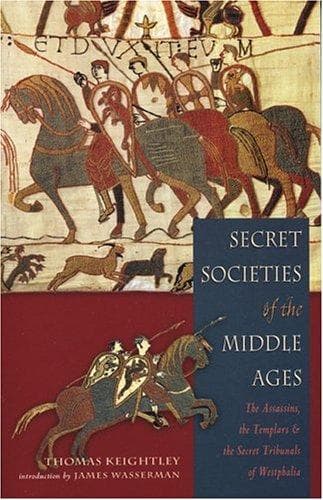
Secret Societies of the Middle AgesKeightley, Thomas
History
Secret Societies of the Middle Ages
Keightley, Thomas
Secret societies
Though, like all other proprietors in the Holy Land, the order of the
Temple had been losers in consequence of the conquest of it by Saladin,
their possessions in the West were so extensive that they hardly felt
the loss. At this very time we find the number of their possessions of
various kinds in Europe, stated at 7050, principally situated in France
and in England. Their arrogance and luxury naturally kept pace with
their wealth; and, though writers of the twelfth century, and even the
Troubadours--the satirists of the age--always speak of the knights of
the Temple with honour, there was a secret dislike of them gaining
ground, especially with the clergy, in consequence of the great
privileges granted to them by the bull _Omne Datum Optimum_, and the
insolent manner in which these privileges were exercised.
Accordingly we find, in the year 1208, the great Innocent III. the most
ambitious of popes, and one who was a steady friend to the order, under
the necessity of passing the first public censure of them, and
endeavouring to set, by authority, a limit to their excesses. In his
epistle to the Master on this occasion, the holy father says that they
abused the privilege of having mass celebrated in places which were
under interdict, by causing their churches to be thrown open, and mass
to be said every day, with loud ringing of bells, bearing the cross of
Christ on their breast, but not caring to follow his doctrines, who
forbids to give offence to any of the little ones who believe on him. He
goes on to state that, following the doctrines of demons, they affixed
the cross of their order on the breast of (i.e. _affiliated_) every kind
of scoundrel, asserting that whoever, by paying two or three pence a
year, became one of their fraternity, could not, even though
interdicted, be deprived of Christian burial; and that hence, known
adulterers, usurers, and others who were lying under sentence of
interdict, were honourably interred in their cemeteries; "and thus they
themselves, being captive to the devil, cease not to make captive the
souls of the faithful, seeking to make alive those whom they know to be
dead." The pontiff laments, that instead of, like religious men, using
the world for the sake of God, they employed their religious character
as a means of indulging in the pleasures of the world. Though, on
account of these and such abuses, they deserved to be deprived of the
privileges which had been conferred on them, the holy father will not
proceed to extremity, relying on the exertions of the Master to effect a
reformation.
Public-domain text, read in full here on John Shaqi.
Reviews
Reviews
No reviews yet
Be the first to share your thoughts on this work.
Elsewhere in the archive
Join the Discussion
Join the discussion
Sign in to leave a comment or review.
Sign InorCreate an account