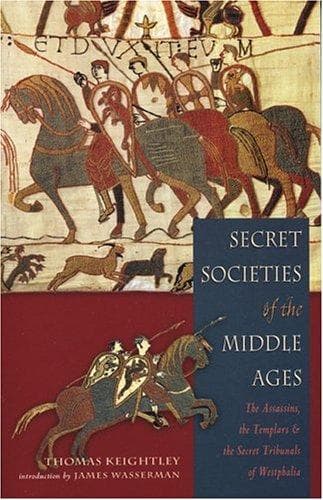
Secret Societies of the Middle AgesKeightley, Thomas
History
Secret Societies of the Middle Ages
Keightley, Thomas
Secret societies
The mountains of Armenia and the course of the Euphrates separated the
Eastern Empire from that of Persia. This country had been under the
dominion of the people named Parthians at the time when the eagles of
the Roman republic first appeared on the Euphrates, and defeat had more
than once attended the Roman armies which attempted to enter their
confines. Like every dominion not founded on the freedom of the people,
that of the Arsacides (the Parthian royal line) grew feeble with time,
and after a continuance of nearly five centuries the sceptre of Arsaces
passed from the weak hand of the last monarch of his line to that of
Ardeshir Babegan (that is the son of Babec), a valiant officer of the
royal army, and a pretended descendant of the ancient monarchs of
Persia. Ardeshir, to accomplish this revolution, availed himself of the
religious prejudices of the Persian people. The Parthian monarchs had
inclined to the manners and the religion of the Greeks, and the
Light-religion--the original faith of Persia, and one of the purest and
most spiritual of those to which a divine origin may not be
assigned--had been held in slight estimation, and its priests unvisited
by royal favour. It was the pride and the policy of Ardeshir to restore
the ancient religion to the dignity which it had enjoyed under the
descendants of Cyrus, and Religion, in return, lent her powerful aid to
his plans of restoring the royal dignity to its pristine vigour, and of
infusing into the breast of the people the love of country and the
ardour for extending the Persian dominion to what it had been of old;
and for 400 years the Sassanides[4] were the most formidable enemies of
the Roman empire. But their dominion had, at the period of which we
write, nearly attained the greatest limit allotted to Oriental
dynasties; and though Noosheerwan the Just had attained great warlike
fame, and governed with a vigour and justice that have made his name
proverbial in the East, and Khoosroo Purveez displayed a magnificence
which is still the theme of Persian poetry and romance, and carried his
victorious arms over Syria and Egypt, and further along the African
coast than even those of Darius I. had been able to advance, yet defeat
from the gallant Emperor Heraclius clouded his latter days, and the
thirteenth year after his death, by showing the Persian armies in
flight, and the palladium of the empire, the jewel-set apron of the
blacksmith Kawah, in the hands of the rovers of the deserts, revealed
the secret that her strength was departed from Persia. The brilliancy
of the early part of the reign of Khoosroo Purveez had been but the
flash before death which at times is displayed in empires as in
individuals. The vigour was gone which was requisite to stem the torrent
of fanatic valour about to burst forth from the wilds of Arabia.
Public-domain text, read in full here on John Shaqi.
Reviews
Reviews
No reviews yet
Be the first to share your thoughts on this work.
Join the Discussion
Join the discussion
Sign in to leave a comment or review.
Sign InorCreate an account