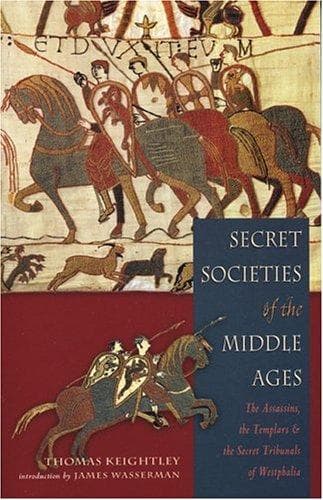
Secret Societies of the Middle AgesKeightley, Thomas
History
Secret Societies of the Middle Ages
Keightley, Thomas
Secret societies
XI. Apulia and Sicily.--The possessions of the Templars in Sicily were
very considerable. They had houses and lands at Syracuse, Palermo,
Trapani, Butera, Lentini, &c.; all of which were dependent on the
principal house, which was in Messina. The great-prior resided either at
Messina or at Benevento in Apulia. Possibly the seat was removed to this
last place, after the Emperor Frederic II. had seized so much of the
property of the order in Sicily.
In Denmark, Norway, and Sweden, the order had no possessions whatever.
Though the people of these countries took some share in the crusades,
and were, therefore, not deficient in religious zeal, their poor and
little-known lands offered no strong inducements to the avarice or
ambition of the knights of the Temple, and they never sought a
settlement in them.
We thus see that, with the exception of the northern kingdoms, there was
no part of Europe in which the order of the Temple was not established.
Everywhere they had churches, chapels, tithes, farms, villages, mills,
rights of pasturage, of fishing, of venery, and of wood. They had also,
in many places, the right of holding annual fairs, which were managed,
and the tolls received, either by some of the brethren of the nearest
houses or by their _donates_ and servants. The number of their
preceptories is, by the most moderate computation, rated at 9,000; and
the annual income of the order at about six millions sterling--an
enormous sum for those times! Masters of such a revenue, descended from
the noblest houses of Christendom, uniting in their persons the most
esteemed secular and religious characters, regarded as the chosen
champions of Christ, and the flower of Christian knights, it was not
possible for the Templars, in such lax times as the twelfth and
thirteenth centuries, to escape falling into the vices of extravagant
luxury and overweening pride. Nor are we to wonder at their becoming
objects of jealousy and aversion to both the clergy and the laity, and
exciting the fears and the cupidity of an avaricious and faithless
prince.
CHAPTER VII.
Officers of the Order--The Master--Mode of Election--His
Rights and Privileges--Restraints on him--The Seneschal--The
Marshal--The Treasurer--The Draper--The Turcopilar--Great-
Priors--Commanders--Visitors--Sub-Marshal--Standard-bearer.
An order consisting of so many members, and whose wealth and possessions
were of such extent, must necessarily have had numerous officers and
various ranks and dignities. The elucidation of this branch of their
constitution is now to engage our attention.
Public-domain text, read in full here on John Shaqi.
Reviews
Reviews
No reviews yet
Be the first to share your thoughts on this work.
Elsewhere in the archive
Join the Discussion
Join the discussion
Sign in to leave a comment or review.
Sign InorCreate an account