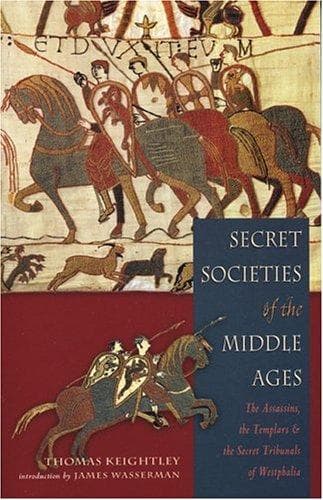
Secret Societies of the Middle AgesKeightley, Thomas
History
Secret Societies of the Middle Ages
Keightley, Thomas
Secret societies
At the head of the order stood the Master, or, as he was sometimes
called, the Great-Master[86] of the Temple. This personage was always a
knight, and had generally held one of the higher dignities of the order.
Though, like the Doge of Venice, his power was greatly controlled by the
chapter, he enjoyed very great consideration, and was always regarded as
the representative of the order. In the councils, the Masters of the
Temple and the Hospital took precedence of all ambassadors, and sat next
the prelates. All monarchs conceded princely rank and place to the
Master of the Temple.
[Footnote 86: _Magister_, _Maistre_, is the almost invariable expression
in the historians, the statutes of the order, and most documents.
_Magnus Magister_ was, however, early employed. Terricus, the Master of
the order, thus styles himself when writing to Henry II. of England. The
term Grand-Master is apt to convey erroneous ideas of pomp and
magnificence to the minds of many readers.]
A situation which offered so much state and consideration must, of
necessity, have been an object of ambition; but the scanty records
remaining of the society do not enable us to point out any specific
cases of intrigue employed for the attainment of it. That of the last
Master, hereafter to be mentioned, is somewhat problematic.
The election of a Master of the Temple was as follows:--
When the Master was dead, an event which always occurred in the East, as
he was bound to reside there, if it took place in the kingdom of
Jerusalem, and the marshal of the order was on the spot, he took upon
him the exercise of the vacant dignity till, with the aid of the chapter
and of all the bailiffs on this side of the sea (_i. e._ in the East), he
had appointed a great-prior to represent the Master. But this election
did not take place till after the funeral. Should the death of the
Master have occurred in the province of Tripolis, or that of Antioch,
the prior of the province took the direction of the order till the
great-prior was appointed.
Owing to the constant state of war which prevailed in the East, and to
other causes, a considerable space of time occasionally intervened
between the death of one Master and the appointment of his successor.
During the _interregnum_ the society was directed by the great-prior who
bore the seal of the Master.
Public-domain text, read in full here on John Shaqi.
Reviews
Reviews
No reviews yet
Be the first to share your thoughts on this work.
Elsewhere in the archive
Join the Discussion
Join the discussion
Sign in to leave a comment or review.
Sign InorCreate an account