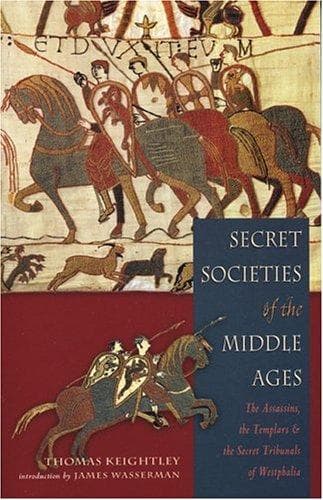
Secret Societies of the Middle AgesKeightley, Thomas
History
Secret Societies of the Middle Ages
Keightley, Thomas
Secret societies
When the day appointed for the election was arrived, the great officers
of the order and all the bailiffs who were invited to be present
assembled in the place selected for holding the election--generally the
chapel of the order. The great-prior, taking several of the knights
aside, consulted with them; and they then made two or three or more of
the knights who were most highly-esteemed retire. The great-prior took
the voices of those present on the merits of the absent knights; and he
who had most in his favour was declared the electing-prior. The knights
were then called in, and the choice of the assembly notified to them. A
knight, possessing the same virtues of piety, love of peace, and
impartiality with himself, was then assigned for an assistant to the
electing-prior: and the whole assemblage withdrew, leaving the two alone
in the chapel, where they passed the entire night in prayer.
Early next morning, after performing their usual devotions and hearing
the mass of the Holy Ghost, the chapter re-assembled. The great-prior
then exhorted the two electing brethren to perform their duty truly and
honestly. These, then retiring, chose two other brethren; these four
chose two more, and so on, till the number amounted to twelve, in honour
of the apostles. The twelve then chose a brother-chaplain to represent
the person of Jesus Christ, and maintain peace and concord. It was
necessary that these thirteen should be of different provinces--eight of
them knights, four serving-brethren, and one priest. The thirteen
electors then returned to the chapter, and the electing-prior besought
all present to pray for them, as a great task had been laid on them. All
then fell on their knees and prayed; and the great-prior solemnly
reminded the electors of their duty, and conjured them to perform it
truly and uprightly. Having again implored the prayers of the assembly,
the electing-prior and his companions retired to the place appointed for
their deliberations. If the electors, or the majority of them, declared
for any knight on this or the other side of the sea, he was appointed;
if they were divided into parties, the electing-prior came with one of
the knights, and, informing the assembly of the circumstance, asked
their prayers. All fell on their knees, and the two electors returned
to their companions; if they now agreed, the person whom they chose was
declared Master.
Public-domain text, read in full here on John Shaqi.
Reviews
Reviews
No reviews yet
Be the first to share your thoughts on this work.
Elsewhere in the archive
Join the Discussion
Join the discussion
Sign in to leave a comment or review.
Sign InorCreate an account