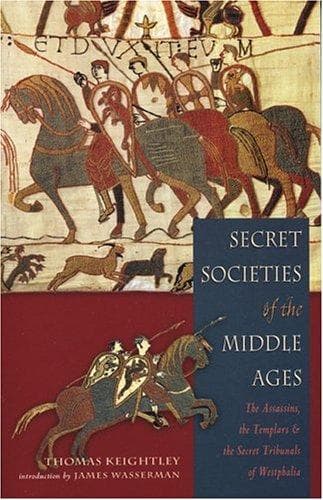
Secret Societies of the Middle AgesKeightley, Thomas
History
Secret Societies of the Middle Ages
Keightley, Thomas
Secret societies
The allowances and train of the Master were suitable to the rank which
he was to support in the world, and to the dignity of the order which he
represented. He was allowed four horses, and an esquire of noble birth.
He had a chaplain and two secretaries; one for managing his Latin
correspondence, whom he might, after a time, admit to become a knight of
the order; the other, who was called his Saracenic secretary, and who
was probably an eastern Christian, for carrying on his Arabic
correspondence with the Infidels. He had, moreover, a farrier, a cook,
and a Turcopole[87], two footmen, and a Turcoman[88], to serve as guide.
On a march, the Turcoman rode on a horse behind an esquire: during the
time of war he was led by a cord, to prevent his escape. On any ordinary
journey, the Master might take two beasts of burden with him; but in
war-time, or in case of his going beyond the Jordan, or the Dog's
Pass[89], he might extend the number to four, which the statutes
thriftily direct to be put into the stable when he arrives at the house
where he is going to stop, and to be employed in the service of the
house. The Master was finally commander-in-chief of the order in the
field; and then, like the Spartan kings, he could act in some degree
unfettered by the chapter. When he died, he was buried with great
solemnity and pomp, by the light of torches and wax tapers--an honour
bestowed by the order on no other of its members. All the knights were
required to attend the funeral; and the prelates were invited to give
their presence at it. Each brother who was present was to repeat 200
_Pater nosters_ within seven days, for the repose of the soul of the
deceased; and 100 poor persons were fed at home in the evening, with the
same design.
[Footnote 87: The Turcopoles were the offspring of a Turkish father, by
a Christian mother; or also those who had been reared among the Turks,
and had learned their mode of fighting. The Christians employed them as
light cavalry; and the Templars had always a number of them in their
pay.]
[Footnote 88: The Turcomans were, as their name denotes, born Turks. The
Christians used them as guides on their expeditions.]
[Footnote 89: _Le pas de chien._ Münter (p. 66) declares his ignorance
of where it lay. It was evidently the dangerous pass at the
Nahr-el-Kelb, (_Dog's River_), near the sea, on the way to Antioch.]
Public-domain text, read in full here on John Shaqi.
Reviews
Reviews
No reviews yet
Be the first to share your thoughts on this work.
Elsewhere in the archive
Join the Discussion
Join the discussion
Sign in to leave a comment or review.
Sign InorCreate an account