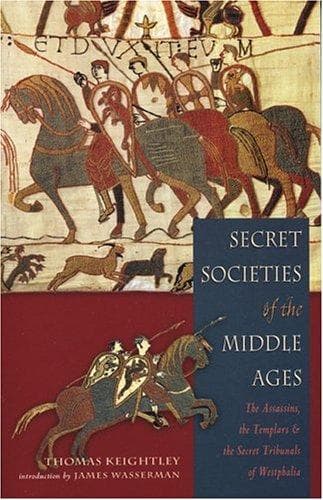
Secret Societies of the Middle AgesKeightley, Thomas
History
Secret Societies of the Middle Ages
Keightley, Thomas
Secret societies
On the other hand, the Master was bound to obey the chapter; and he
could do nothing without consulting some of the brethren. He could not
nominate to any of the higher dignities of the order; but he might, with
the advice and consent of some of the most reputable knights, appoint to
the inferior priories and preceptories. He could not sell, or in any
other way dispose of, any of the lands of the order, without the consent
of the chapter; neither could he make peace or truce without their
approbation. Their consent was also required to enable him to make any
alteration in the laws of the society, to receive any person into it, or
to send a brother beyond sea. He could take no money out of the treasury
without the consent of the prior of Jerusalem, who was the treasurer of
the society. In fact, the Master of the Temple was so curbed and
restrained in every way, and his office made so much an honorary one,
that his dignity may best be compared with that of a Spartan king or a
Venetian doge. It is rather curious that the Master of the Temple should
be thus limited in authority, when the abbot of the Benedictines, whose
rules the Templars in a great measure adopted, enjoyed monarchical
power.
Next in rank to the Master stood the seneschal, who, as his name
denotes[90], was the Master's representative and lieutenant. He had a
right to be present at all chapters of the order; and to be acquainted
with all transactions of consequence. He was allowed the same number of
horses as the Master; but, instead of a mule, he was to have a palfrey:
he had two esquires, and was assigned a knight as his companion; a
deacon acted as his chaplain and Latin secretary; he had also a
Saracenic secretary and a Turcopole, with two footmen. Like the Master,
he bore the seal of the order.
[Footnote 90: Seneschal is one _qui alterius vicem gerit_. Charpentier
Supplem. ad Dufresne Gloss. iii. p. 759.]
The marshal was the general of the order; he had charge of the banner,
and led the brethren to battle. All the arms, equipments, and stables of
the order were under his superintendence. It was he who nominated the
sub-marshal and the standard-bearer. Like all the other great officers,
he was appointed by the Master and the chapter. As we have seen, when
the Master died in the kingdom of Jerusalem, the marshal occupied his
place till a great-prior was chosen. The marshal was allowed four
horses, two esquires, a serving-brother, and a Turcopole.
Public-domain text, read in full here on John Shaqi.
Reviews
Reviews
No reviews yet
Be the first to share your thoughts on this work.
Elsewhere in the archive
Join the Discussion
Join the discussion
Sign in to leave a comment or review.
Sign InorCreate an account