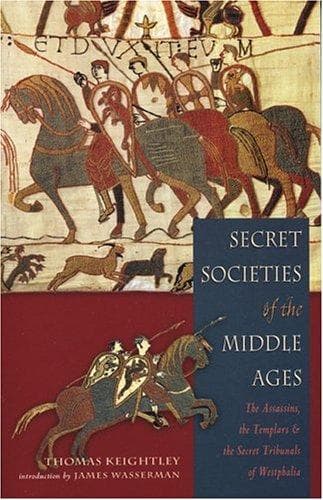
Secret Societies of the Middle AgesKeightley, Thomas
History
Secret Societies of the Middle Ages
Keightley, Thomas
Secret societies
Besides the foregoing offices, which were almost exclusively confined to
the knights, there were some inferior ones appropriated to the
serving-brethren. These offices were five in number--namely, those of
sub-marshal, standard-bearer, farrier, cook, and preceptor of the coast
of Acre. Each of these was allowed two horses.
The sub-marshal had the charge of all the inferior sort of accoutrements
(_le petit harnois_) of the order, in which the horse-furniture seems to
have been included. All the handicraftsmen of the order were under him,
and were obliged to account to him for their work. He supplied them with
the needful tools and materials; could send them where he pleased on the
service of the house; and on holidays give them permission to go from
one house to another to amuse themselves. The sub-marshal and the
standard-bearer were each the representative of the other in his
absence.
The standard-bearer had the command over all the esquires of the house;
that is, those who were engaged for a limited time in the service of the
order, whom he was bound to make acquainted with the rules to which they
were subject, and the punishments to which they were liable in case of
disobedience; he was also to pay them their wages. Whenever the esquires
took the horses out to graze, he was bound to precede them with a
standard of the order. He always presided at the table of the
serving-brethren and esquires. When the order was marching to battle, it
was his task to ride before the standard, which was borne after him by
an esquire, or carried on a wain[91]; he was to lead whithersoever the
marshal directed him. When the battle commenced, those esquires who led
the horses of the knights were to combat behind their masters; the
others were to take the mules on which their masters rode, and remain
with the standard-bearer, who was to have a banner rolled about his
lance, which, when he saw the marshal engaged in action, he was to
unfurl, and draw up the esquires in as handsome order as possible behind
the combatants, in order to support them.
[Footnote 91: The _Carroccio_ of the Italian republics.]
Public-domain text, read in full here on John Shaqi.
Reviews
Reviews
No reviews yet
Be the first to share your thoughts on this work.
Elsewhere in the archive
Join the Discussion
Join the discussion
Sign in to leave a comment or review.
Sign InorCreate an account