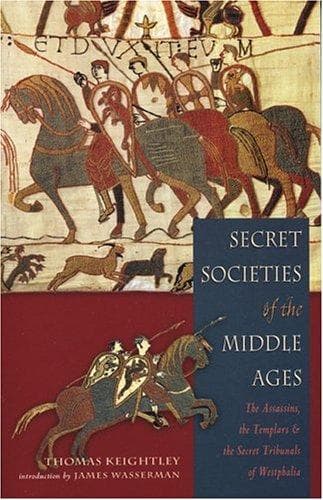
Secret Societies of the Middle AgesKeightley, Thomas
History
Secret Societies of the Middle Ages
Keightley, Thomas
Secret societies
When the true cross was brought forth on any expedition, it was the duty
of the prior of Jerusalem to keep by it, with his ten knights, night and
day, and to guard it; he was to encamp close to it; and two brethren
were to watch it every night.
All the secular knights who associated themselves to the order in
Jerusalem were under his orders, and fought beneath his banner. All the
brethren of the order who were in Jerusalem were, in the absence of the
marshal, under his command. One half of the booty captured beyond the
Jordan fell to him, the other half to the prior of the kingdom.
As we have seen above, the West was, like the East, divided into
provinces of the order. Each of these provinces was presided over by a
lieutenant of the master, named the provincial-master, great-prior, or
great-preceptor, with his chapter and officers corresponding to those of
the kingdom of Jerusalem. He was appointed, as it would appear, by the
Master and chapter; and when entering on his office, he bound himself by
oath to defend the Catholic religion, not only with his lips, but with
arms and all his strength; to follow the rules drawn up by St. Bernard;
to obey the Master; to come over the sea to his aid whenever it was
necessary; to defend him against all unbelieving kings and princes; not
to fly before these unbelieving foes; not to alienate the goods of the
order; to be loyal to the prince of the country; to be chaste; and to
aid all spiritual persons, especially the Cistercians, by words and by
deeds.
Under the provincial-masters stood the priors, bailiffs, or masters, who
governed large districts of the provinces, and had under their
inspection several of the houses of the order and their preceptors. They
dwelt in large temple-houses, with a good number of knights; they had
the power of holding chapters, and of receiving members into the order.
The preceptors were subordinate to the priors; they presided over one or
more houses. They were generally knights, but they were sometimes
priests. They were of two kinds--house-preceptors and knight-preceptors;
the former, as their name denotes, merely presided over the houses, and
might be priests or serving-brethren; the latter, who were probably only
to be found in the East or in Spain, led each ten knights in the battle.
Another office to be found among the Templars was that of visitors.
These were knights, who, as the representatives of the Master, visited
the different provinces of the order, especially in the West, to reform
abuses, make new regulations, and terminate such disputes and law-suits
as were usually reserved for the decision of the Master and the chapter.
All the provincial officers, even the great-priors, were subject to the
visitors, as the representatives of the Master. The powers of the
visitors ceased as soon as the business ended for which they were sent,
or when they were recalled.
[Illustration: Preceptory, Swingfield, Dover]
Public-domain text, read in full here on John Shaqi.
Reviews
Reviews
No reviews yet
Be the first to share your thoughts on this work.
Elsewhere in the archive
Join the Discussion
Join the discussion
Sign in to leave a comment or review.
Sign InorCreate an account