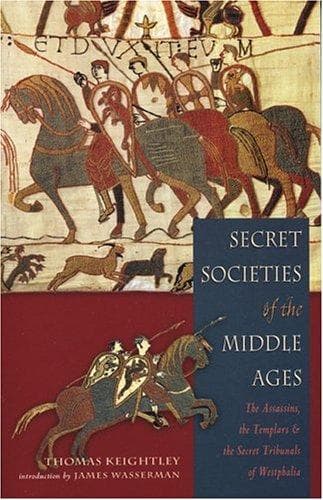
Secret Societies of the Middle AgesKeightley, Thomas
History
Secret Societies of the Middle Ages
Keightley, Thomas
Secret societies
the holy kingdom of Jerusalem, for the order and all its houses and
people, for the brethren and sisters of the order, and for its living
and dead benefactors; finally, for all the dead who waited for the mercy
of God, especially those who lay buried in the Temple burial-grounds,
and for the souls of the fathers and mothers of the Templars. The
chaplain, if present, repeated a confession of sin, in which all
followed him, and then pronounced an absolution. If there was no
chaplain present, each brother repeated a _pater_ and an _ave_, and so
the chapter ended.
The statutes of the order are full of the most minute directions
respecting the equipment, clothing, and mode of living of the various
members of the order. They were obliged to attend divine service
punctually each day at all the different hours at which it was
celebrated, and regularly to observe all the fasts of the church; they
were also to have at their houses both public and private devotions.
Their meals were also strictly regulated. They assembled by sound of
bell: if there was a priest in the house he said grace for them, if not,
each brother repeated a _pater_ before he began to eat. During the meal
a clergyman read out something edifying for them, and when it was over
no one was to speak till grace was said. There was no difference made in
the quality of the food; all, both high and low, fared alike, and they
ate two off one plate. They had flesh-meat but three times a week,
unless when festival days occurred. On days when they had no flesh-meat
they had but two dishes. When the order were in the field a server
regulated the supply and distribution of provisions. Before giving out
the provisions he was to direct the serving-brethren to notify it to the
superiors of the order, that they might come and select the best for
themselves; he distributed the remainder without any other distinction
than that of giving the best to the sick. The plate given to every two
of the brethren was so large that what remained when they were done was
sufficient to satisfy two of the poor. Two brethren were allowed as much
food as three Turcopoles, and two of these as much as three of the
servants. The brethren were not allowed to seek for any food elsewhere
than from the server, vegetables, game, and venison excepted. But as by
the rules of the order the chase was prohibited to them, they could not
procure these themselves.
Public-domain text, read in full here on John Shaqi.
Reviews
Reviews
No reviews yet
Be the first to share your thoughts on this work.
Elsewhere in the archive
Join the Discussion
Join the discussion
Sign in to leave a comment or review.
Sign InorCreate an account