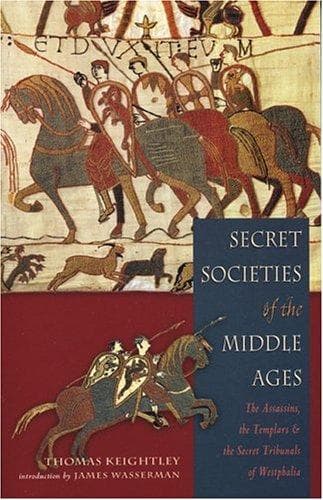
Secret Societies of the Middle AgesKeightley, Thomas
History
Secret Societies of the Middle Ages
Keightley, Thomas
Secret societies
The ordinary chapters were held in the following manner. Each brother,
as he entered, made the sign of the cross, and, unless he was bald, took
off his cap. The president then rose and said, "Stand up, beloved
brethren, and pray to God to send his holy grace among us to-day." Each
member repeated a _pater noster_, and, if there was a chaplain present,
he said a prayer. Search was then made to see that there was no one
present but those who belonged to the order. The president then
delivered a discourse, exhorting the brethren to amendment of life.
During this discourse no one was on any account to leave the room. When
it was ended, any one who had transgressions to acknowledge went up to
the president and made confession. He then retired out of sight and
hearing, and the sentiments of the assembly were taken, which were
afterwards signified to him. The brethren were also to remind each other
of their transgressions, and exhort to confession and penitence. If any
one accused a brother falsely, he was severely punished for it: while
the inquiry was going on the accused was obliged to retire from the
chapter. The discipline was usually administered in presence of the
assembled chapter, with a scourge, or with a girdle. Those who were sick
were not punished till they were recovered.
When these matters were over, the president explained a portion of the
statutes, and exhorted all present to live suitably thereto. He then
said, "Beloved brethren, we may now close our chapter, for, praise be to
God, all is well; and may God and our dear Lady grant that it may so
continue, and goodness be every day increased. Beloved brethren, ye must
know how it is with pardon in our chapter, and who has not part therein;
know, then, that those have no part either in the pardon of our chapter,
or in the other good works of the chapter; who live as they should not;
who depart from the righteousness of the order; who do not acknowledge
their offences and do penance in the mode prescribed by the order; who
treat the alms of the order as their own property, or in any other way
contrary to law, and squander them in an unrighteous, scandalous, and
foolish manner. But those who honestly acknowledge their faults, and
conceal nothing out of shame or fear of the punishment of the order, and
are right sorry for their transgressions, have a large share in the
forgiveness of our chapter, and in the good works which take place in
our order. And to such, in virtue of my authority, I dispense
forgiveness in the name of God and of our dear Lady, in the names of the
apostles Peter and Paul, of our father the pope, and of you all who have
given me authority; and pray to God that, according to his mercy, he
will, for the merits of his mother, and of himself, and all the saints,
forgive you your sins, as he forgave the famous Mary Magdalene." He then
implored the forgiveness of those to whom he might have given any
offence or done any injury; and prayed for peace, for the church, for
Public-domain text, read in full here on John Shaqi.
Reviews
Reviews
No reviews yet
Be the first to share your thoughts on this work.
Elsewhere in the archive
Join the Discussion
Join the discussion
Sign in to leave a comment or review.
Sign InorCreate an account