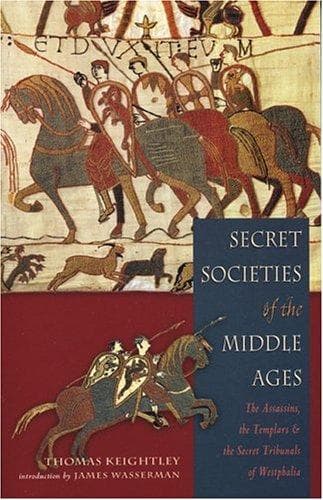
Secret Societies of the Middle AgesKeightley, Thomas
History
Secret Societies of the Middle Ages
Keightley, Thomas
Secret societies
In the year 1297, when the order had established its head-quarters in
the isle of Cyprus, James de Molay, a native of Besançon, in the Franche
Comté, was elected Master. The character of Molay appears to have been
at all times noble and estimable; but if we are to credit the statement
of a knight named Hugh de Travaux, he attained his dignity by an
artifice not unlike that said to have been employed by Sixtus V. for
arriving at the papacy. The chapter, according to De Travaux, could not
agree, one part being for Molay, the other, and the stronger, for Hugh
de Peyraud. Molay, seeing that he had little chance of success, assured
some of the principal knights that he did not covet the office, and
would himself vote for his competitor. Believing him, they joyfully made
him great-prior. His tone now altered. "The mantle is done, now put the
hood on it. You have made me great-prior, and whether you will or not I
will be great-master also." The astounded knights instantly chose him.
If this account be true, the mode of election at this time must have
differed very considerably from that which we have described above out
of the statutes of the order. This election, moreover, took place in
France, where, in 1297, Molay, we are told, held the fourth son of the
king at the baptismal font.
One feeble attempt, the last military exploit of the Templars, was made
by the Christians to acquire once more a footing on the continent of
Asia during the mastership of Molay. In 1300, the Mongol chief Gazan
came to the aid of the king of Armenia, against the Turks. As it was the
policy of the Tartars, who had not as yet embraced Islam, to stir up
enemies to the Mohammedans, Gazan, after over-running the country as
far as Damascus, sent an embassy to the Pope, Boniface VIII., inviting
the Christians, particularly the three military orders, to come and take
possession of the Holy Land. The Templars, Hospitallers, and Henry, king
of Cyprus, forthwith manned seven galleys and five smaller vessels.
Almeric de Lusignan, Lord of Tyre, and the Masters of the two orders,
landed at Tortosa, and endeavoured to maintain that islet against the
Egyptian sultan, but were forced to yield to numbers. The Templars
fought gallantly to no purpose, and a few of them, who defended a tower
into which they had thrown themselves, surrendered, and were carried
prisoners to Egypt.
The Hospitallers, in the year 1306, renewed their attacks on the isle of
Rhodes, where they finally succeeded in expelling the Turks, and
planting the standard of their order. The Teutonic knights transferred
the sphere of their warfare to Russia, and the adjacent country, whose
inhabitants were still heathens. The Templars meantime remained inactive
in Cyprus, and seem even to have been meditating a retreat to Europe.
Public-domain text, read in full here on John Shaqi.
Reviews
Reviews
No reviews yet
Be the first to share your thoughts on this work.
Elsewhere in the archive
Join the Discussion
Join the discussion
Sign in to leave a comment or review.
Sign InorCreate an account