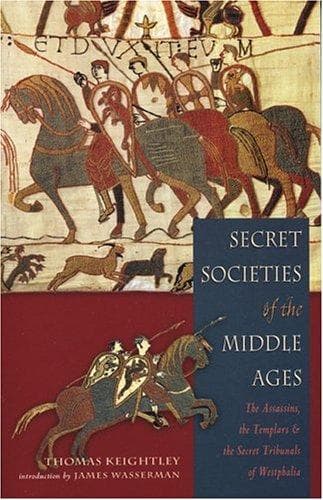
Secret Societies of the Middle AgesKeightley, Thomas
History
Secret Societies of the Middle Ages
Keightley, Thomas
Secret societies
France was at this time governed by Philip the Fair, son of St. Louis.
Philip, who had come to the throne at the early age of seventeen years,
had been educated by Giles de Colonna, afterwards archbishop of Bourges,
a man distinguished for his learning and for the boldness of his
opinions. One of his favourite maxims was, "that Jesus Christ had not
given any temporal dominion to his church, and that the king of France
has his authority from God alone." Such principles having been early
instilled into his mind, the young monarch was not likely to be a very
dutiful son of the Church, and the character of Boniface VIII., who,
without possessing the talents or the virtues of a Gregory or an
Innocent, attempted to stretch the papal pretensions to their greatest
extent, soon roused him to resistance. In the plenitude of his fancied
authority, the pope issued a bull, forbidding the clergy to give any
subsidies to lay-powers without permission from Rome. Philip, in return,
issued an order prohibiting the exportation of gold, silver, or
merchandize from France, thereby cutting off a great source of papal
revenue. In the course of the dispute, Boniface maintained that princes
were subject to him in temporals also. Philip's reply was,--"Philip, by
the grace of God, king of the French, to Boniface, acting as supreme
pontiff, little or no health. Let your extreme folly know, that in
temporals we are not subject to any one." Shortly afterwards he publicly
burned a bull of the pope, and proclaimed the deed by sound of trumpet
in Paris. Boniface, raving with indignation, summoned the French clergy
to Rome, to deliberate on the means of preserving the liberties of the
Church. Philip convoked a national assembly to Paris, in which, for the
first time, there appeared deputies of the third estate, who readily
expressed their resolution to stand by their monarch in defence of his
rights, and the clergy willingly denied the temporal jurisdiction of the
pontiff. Several prelates and abbots having obeyed the summons of the
pope, the king seized on their temporalities. The pope menaced with
deprivation all those who had not attended, and, in his famous bull of
_Unam sanctam_, asserted that every human being was subject to the Roman
pontiff. Another bull declared that every person, be his rank what it
might, was bound to appear personally when summoned to Rome. Philip
forbade the publication of these bulls; and the states general being
again convoked appealed to a council against the pope. Commissaries were
sent through France to procure the adhesion of the clergy to this act,
which was given in some cases voluntarily, in others obtained by means
of a little wholesome rigour. The king, his wife, and his son, pledged
themselves to stand by those who adhered to the resistance made by
France to papal usurpation. Boniface next excommunicated the king, who
intercepted the bull, and prevented its publication. The pope finally
Public-domain text, read in full here on John Shaqi.
Reviews
Reviews
No reviews yet
Be the first to share your thoughts on this work.
Elsewhere in the archive
Join the Discussion
Join the discussion
Sign in to leave a comment or review.
Sign InorCreate an account