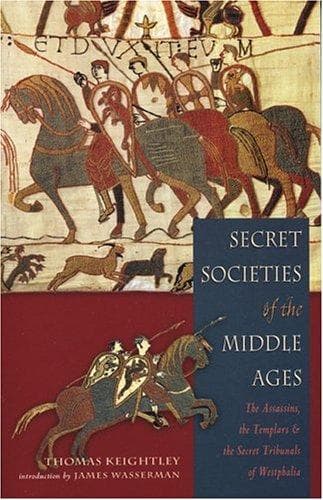
Secret Societies of the Middle AgesKeightley, Thomas
History
Secret Societies of the Middle Ages
Keightley, Thomas
Secret societies
offered the crown of France to the emperor Albert of Austria. Matters
were now come to an extremity, and Philip ventured on one of the boldest
acts that have ever been attempted in the Christian world.
Philip had afforded an asylum at his court to some members of the
Colonna family, the personal enemies of the pope. His chancellor and
fast adherent was William de Nogaret, who had been his agent in the
affair of appealing to a general council, by presenting to the states
general a charge of simony, magic, and the usual real or imaginary
crimes of the day against the pontiff. This man, and some of the Italian
exiles, attended by a body of 300 horse, set out for Italy, and took up
his abode at a castle between Florence and Sienna, under pretext of its
being a convenient situation for carrying on negociations with Rome. The
pope was meantime residing at Anagni, his native town. Nogaret having,
by a liberal distribution of money, acquired a sufficient number of
partisans, appeared before the gate of Anagni early on the morning of
the 7th September, 1303. The gate was opened by a traitor, and the
French and their partisans ran through the streets, crying _Live the
king of France, die Boniface_. They entered the palace without
opposition; the French ran here and there in search of plunder, and
Sciarra Colonna and his Italians alone came in presence of the pope.
Boniface, who was now eighty-six years of age, was clad in his
pontifical vestments, and on his knees before the altar, in expectation
of death. At the sight of him the conspirators, whose intention had been
to slay him, stopped short, filled with involuntary awe, and did not
dare to lay a hand upon him. During three days they kept him a
prisoner; on the fourth the people of the town rose and expelled them,
and released the pontiff. Boniface returned to Rome; but rage at the
humiliation which he had undergone deranged his intellect, and in one of
his paroxysms he dashed his head against the wall of his chamber, and
died in consequence of the injury which he received[95].
[Footnote 95: Sismondi Républiques Italiennes, iv. p. 143.]
Public-domain text, read in full here on John Shaqi.
Reviews
Reviews
No reviews yet
Be the first to share your thoughts on this work.
Elsewhere in the archive
Join the Discussion
Join the discussion
Sign in to leave a comment or review.
Sign InorCreate an account