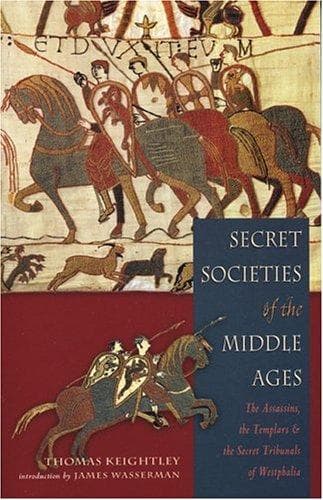
Secret Societies of the Middle AgesKeightley, Thomas
History
Secret Societies of the Middle Ages
Keightley, Thomas
Secret societies
[Footnote 6: The Kubla Khan of Coleridge (Poetical Works, vol. i. p.
266) is a fine instance of this power of the mind, withdrawn from the
contemplation of material objects. The reader will probably recollect
the sign given from heaven to Lord Herbert of Cherbury, on the occasion
of his work written against revealed religion. The writer has lately
heard an instance of a lady of fortune, to whom, as she reclined one day
on a sofa, a voice seemed to come from heaven, announcing to her that
she was selected as the instrument for accomplishing a great work in the
hands of God; and giving, as a sign, that, for a certain number of
months, she should be unable to leave the sofa on which she was lying.
Such is the power of imagination, that the supposed intimation in regard
to the sign actually took effect; she believed herself to have lost the
power of motion, and therefore did in reality lose it.]
Whatever the ideas and projects of Mohammed may originally have been, he
waited till he had attained his fortieth year (the age at which Moses
showed himself first to the Israelites), and then revealed his divine
commission to his wife Khadijah, his slave Zeid, his cousin Ali, the son
of Aboo Talib, and his friend, the virtuous and wealthy Aboo Bekr. It is
difficult to conceive any motive but conviction to have operated on the
minds of these different persons, who at once acknowledged his claim to
the prophetic office; and it speaks not a little for the purity of the
previous life of the new Prophet, that he could venture to claim the
faith of those who were most intimately acquainted with him. The voice
of wisdom has assured us that a prophet has no honour in his own country
and among his own kindred, and the example of Mohammed testified the
truth of the declaration. During thirteen years the new religion made
but slow and painful progress in the town of Mecca; but the people of
Yathreb, a town afterwards dignified with the appellation of the City of
the Prophet (_Medinat-en-Nabi_), were more susceptive of faith; and
when, on the death of Aboo Talib, who protected his nephew, though he
rejected his claims, his celebrated Flight (_Hejra_) brought him to
Yathreb, the people of that town took arms in his defence against the
Koreish. It was probably now that new views opened to the mind of the
Prophet. Prince of Yathreb, he might hope to extend his sway over the
ungrateful Mecca; and those who had scoffed at his arguments and
persuasions might be taught lessons of wisdom by the sword. These
anticipations were correct, and in less than ten years after the battle
of Bedr (the first he fought) he saw his temporal power and his
prophetic character acknowledged by the whole of the Arabian peninsula.
Public-domain text, read in full here on John Shaqi.
Reviews
Reviews
No reviews yet
Be the first to share your thoughts on this work.
Join the Discussion
Join the discussion
Sign in to leave a comment or review.
Sign InorCreate an account