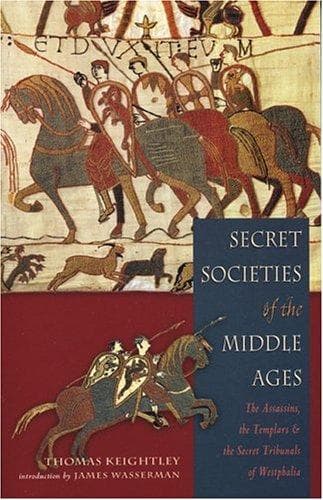
Secret Societies of the Middle AgesKeightley, Thomas
History
Secret Societies of the Middle Ages
Keightley, Thomas
Secret societies
The commission appointed by the pope was composed of the archbishop of
Narbonne, the bishops of Bayeux, Mende, and Limoges; Matthew of Naples,
archdeacon of Rouen, notary of the Holy See; John of Mantua, archdeacon
of Trent; John of Montlaur, archdeacon of Maguelone; and William Agelin,
provost of Aix, which last was prevented by business from giving
attendance. They entered on their functions on the 7th August, 1309, and
ordered that the brethren of the Temple should be cited before them on
the first day of business after the festival of St. Martin, in
November. The citations were to be published in presence of the people
and clergy in the cathedrals, churches, and schools, in the principal
houses of the order, and in the prisons in which the knights were
confined. No one appearing, new citations were issued; and at length the
Bishop of Paris was called on by the commission to go himself to the
prison where the Master and the heads of the order were confined, and
notify it to them. Having done so, he caused the same notification to be
made throughout his diocese. The following circumstance, which occurred
at this time, would seem to indicate that impediments were thrown in the
way of those who were disposed to defend the order by the royal
ministers. The commissioners were informed that the governor of the
Chatelet had arrested and imprisoned some persons who were presumed to
have come to defend the order. The governor being summoned before them,
declared that, by order of the ministers, he had arrested seven persons
who were denounced as being Templars in a lay habit, who had come to
Paris with money in order to procure advocates and defenders for the
accused. He acknowledged that he had put them to the torture, but said
that he did not believe them to be Templars.
On Wednesday, Nov. 26, the commission sat, and Molay, the Master of the
Temple, was brought before it. He was asked if he would defend the
order, or speak for himself. He replied by expressing his surprise that
the Church should proceed with such precipitation in this case, when the
sentence relative to the Emperor Frederic had been suspended for
thirty-two years. Though he had neither knowledge nor talent sufficient
to defend the order, he should consider himself vile in his own eyes,
and in those of others, if he hesitated to do so; but being the
prisoner of the king and the pope, and without money, he asked for aid
and counsel.
The commissioners desired him to reflect on his offer, and to consider
the confessions respecting himself and the order which he had made. They
agreed, however, to give him time; and, that he might not be ignorant of
what was alleged against him, had the documents containing their powers
read to him in the vulgar language.
Public-domain text, read in full here on John Shaqi.
Reviews
Reviews
No reviews yet
Be the first to share your thoughts on this work.
Elsewhere in the archive
Join the Discussion
Join the discussion
Sign in to leave a comment or review.
Sign InorCreate an account