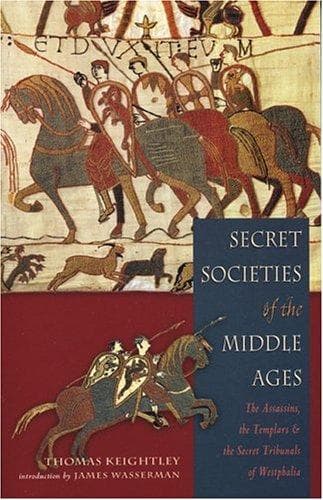
Secret Societies of the Middle AgesKeightley, Thomas
History
Secret Societies of the Middle Ages
Keightley, Thomas
Secret societies
During the reading of the letters which recited his confession made to
the cardinals at Chinon, he crossed himself repeatedly, and gave other
signs of indignation and surprise, and said, that, were it not for the
respect due to the envoys of the pope, he should express himself
differently. They said they were not come there to receive challenges.
He replied that he spoke not of cartels, he only wished they acted in
this case as the Saracens and Tartars did, who cut off the head and cut
the body in two of those who were found to be guilty.
Two circumstances are worthy of note in this examination; one, that
William Plasian was present at it, and, as the commissioners expressly
declared, without being invited by them; the other, that the
confessions, which were imputed to Molay, and which he evidently
intimated to be false, were inserted in the bull _Faciens
misericordiam_, which bears the date of the 12th August, although the
festival of the Assumption, that is the 16th of August, is given as the
day on which they were made[101]. It was there declared that the heads
of the order had confessed and been absolved; yet here we find the
Master treated as a heretic who was still unreconciled.
[Footnote 101: Raynouard, 61. This circumstance was first remarked by
Fleury, _Hist. Eccles._, lib. xci. Yet it seems hardly credible that the
pope and his secretaries could have made so gross a mistake.]
The following day (Nov. 27), Ponsard de Gisi, prior of Payens, appeared
before the commission. On being asked if he would defend the order, he
replied, "Yes; the imputations cast on us of denying Christ, of spitting
on the cross, of authorising infamous crimes, and all such accusations,
are false. If I, myself, or other knights, have made confessions before
the bishop of Paris, or elsewhere, we have betrayed the truth--we have
yielded to fear, to danger, to violence. We were tortured by Flexien de
Beziers, prior of Montfaucon, and the monk William Robert, our enemies.
Several of the prisoners had agreed among themselves to make these
confessions, in order to escape death, and because thirty-six knights
had died at Paris, and a great number in other places, under the
torture. As for me, I am ready to defend the order in my own name, and
in the names of those who will make common cause with me, if I am
assigned out of the goods of the order as much as will defray the
needful expense. I require to be granted the counsel of Raynaud of
Orleans and of Peter of Bologna, priests of the order." He was asked if
he had been tortured. He replied that he had, three months before he
made his confession.
Public-domain text, read in full here on John Shaqi.
Reviews
Reviews
No reviews yet
Be the first to share your thoughts on this work.
Elsewhere in the archive
Join the Discussion
Join the discussion
Sign in to leave a comment or review.
Sign InorCreate an account