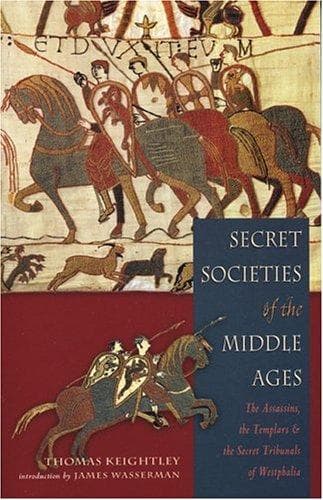
Secret Societies of the Middle AgesKeightley, Thomas
History
Secret Societies of the Middle Ages
Keightley, Thomas
Secret societies
Philip, whose practice it was always to look after his affairs himself,
deeming his presence necessary at Vienne, set out for that place, where
he arrived early in February, accompanied by his three sons, his
brother, and several nobles and men-at-arms. The effect of his presence
was soon perceptible; the pope assembled the cardinals and several other
prelates in a secret consistory, and abolished the order, by his sole
authority, on the 22d March, 1313.
The second session of the council was opened on the 3d April, with great
solemnity; the king of France, his sons, and his brother, gave their
presence at it, and the royal guards appeared for honour, for
protection, or for intimidation. The pope read his bull of abolition.
All present listened in silence. No one ventured to raise his voice in
the cause of justice. The wealthy and powerful order of the knights of
the Temple was suppressed. On the 2d May the bull was published, and the
order as such ceased to exist.
The order being suppressed, persecution became needless, and it
consequently ceased in a great measure. The king and the pope converted
to their own use the moveable property of the order in France. Its other
possessions were, sorely against the will of the king, assigned to the
order of the Hospitallers, who were, however, obliged to pay such large
fines to the king and pope as completely impoverished them. This
extended to all countries, except the Spanish peninsula and Majorca. The
property of the Templars in Aragon was given to the order of Our Lady of
Montesa, which was founded in 1317. Its destination was to combat the
Moors; its habit was similar to that of the Templars; and it might,
therefore, be almost called the same order. Diniz, the able and
enlightened king of Portugal, did not suppress the order, whose
innocence his prelates had recognised. To yield a show of obedience to
the papal will, he made it change its name, and the great-prior of the
Templars in Portugal became the master of the Order of Christ, which has
continued to the present times.
With respect to the remaining Templars, who were in prison, it was
ordered in council that those who should be found guiltless should be
set at liberty, and maintained out of the property of the order; that
the guilty, if they confessed and lamented their offences, should be
treated with mildness; if they did not, dealt with according to the
ecclesiastical law, and kept in custody in the former temple-houses and
in the convents. Those who had escaped were, if they did not appear
within a year before the council or their diocesan, to be
excommunicated.
Public-domain text, read in full here on John Shaqi.
Reviews
Reviews
No reviews yet
Be the first to share your thoughts on this work.
Elsewhere in the archive
Join the Discussion
Join the discussion
Sign in to leave a comment or review.
Sign InorCreate an account