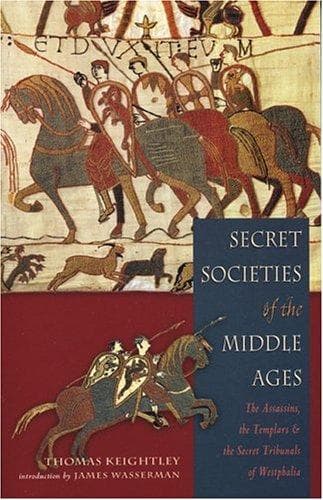
Secret Societies of the Middle AgesKeightley, Thomas
History
Secret Societies of the Middle Ages
Keightley, Thomas
Secret societies
Most of the knights were immediately set at liberty; but the property of
the order was all gone, and no means of support remained for them: they
were, therefore, reduced to the greatest distress, and many of them
obliged to submit to the most menial employment in order to gain a
livelihood. A great number were received into the order of St. John, on
the same footing as they had stood on in their own order--a strong proof
that the guilt of the order of the Templars was not, by any means,
regarded as proved. Gradually, as the members died off, or merged into
other orders, the name of the Templars fell into oblivion, or was only
recollected with pity for their unmerited fate.
While the noble order over which he had presided was thus suppressed,
its members scattered, its property bestowed on others, the Master,
James de Molay, with his three companions, the great-prior of Normandy,
Hugh de Peyraud, visiter of France, and Guy, brother to the Dauphin of
Auvergne, still languished in prison. Molay had there but one attendant,
his cook; the allowance made to him was barely sufficient to procure him
common necessaries, and life had now lost all its value in his eyes. The
pope at length determined to inform the captives of the fate destined
for them.
A papal commission, composed of the bishop of Alba and two other
cardinals, proceeded to Paris, not to hear the prisoners, but, taking
their guilt for proved, to pronounce their sentence. To give all
publicity to this act, probably in accordance with the desire of the
king, a stage was erected in front of the church of Notre Dame, on which
the three commissioners, with the archbishop of Sens and several other
prelates, took their places, on the 18th March, 1314. An immense
concourse of people stood around. The four noble prisoners were
conducted from their dungeons, and led up on the stage. The cardinal of
Alba read out their former confessions, and pronounced the sentence of
perpetual imprisonment. He was then proceeding to expose the guilt of
the order, when the Master interrupted him, and thus spoke, taking all
the spectators to witness:--
"It is just that, in so terrible a day, and in the last moments of my
life, I should discover all the iniquity of falsehood, and make the
truth to triumph. I declare, then, in the face of heaven and earth, and
acknowledge, though to my eternal shame, that I have committed the
greatest of crimes; but it has been the acknowledging of those which
have been so foully charged on the order. I attest, and truth obliges me
to attest, that it is innocent. I made the contrary declaration only to
suspend the excessive pains of torture, and to mollify those who made me
endure them. I know the punishments which have been inflicted on all the
knights who had the courage to revoke a similar confession; but the
dreadful spectacle which is presented to me is not able to make me
confirm one lie by another. The life offered me on such infamous terms I
abandon without regret."
Public-domain text, read in full here on John Shaqi.
Reviews
Reviews
No reviews yet
Be the first to share your thoughts on this work.
Elsewhere in the archive
Join the Discussion
Join the discussion
Sign in to leave a comment or review.
Sign InorCreate an account