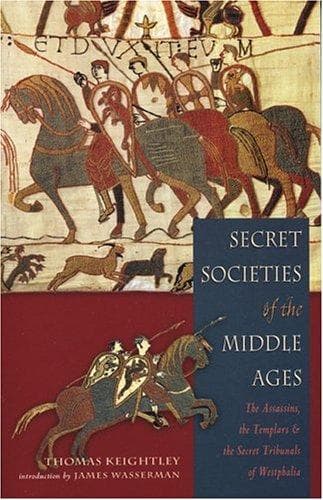
Secret Societies of the Middle AgesKeightley, Thomas
History
Secret Societies of the Middle Ages
Keightley, Thomas
Secret societies
We have seen what the evidence against the Templars was, and it is very
plain that such evidence would not be admitted in any modern court of
justice. It was either hearsay, or given by persons utterly unworthy of
credit, or wrung from the accused by agony and torture. The articles
themselves are absurd and contradictory. Are we to believe that the same
men had adopted the pure deism of the Mahommedans, and were guilty of a
species of idolatry[103] almost too gross for the lowest superstition?
But when did this corruption commence among the Templars? Were those
whom St. Bernard praised as models of Christian zeal and piety, and whom
the whole Christian world admired and revered, engaged in a secret
conspiracy against religion and government? Yes, boldly replies Hammer,
the two humble and pious knights who founded the order were the pupils
and secret allies of the Mahommedan Ismaelites. This was going too far
for Wilike, and he thinks that the guilt of introducing the secret
doctrine lies on the chaplains; for he could discern that the doctrines
of gnosticism, which the Templars are supposed to have held, were beyond
the comprehension of illiterate knights, who, though they could fight
and pray, were but ill qualified to enter into the mazes of mystic
metaphysics. According, therefore, to one party, the whole order was
corrupt from top to bottom; according to another, the secrets were
confined to a few, and, contrary to all analogy, the heads of the order
were frequently in ignorance of them. Neither offer any thing like
evidence in support of their assumption.
[Footnote 103: Almost every charge brought against the Templars had been
previously made against the Albigenses, with how much truth every one is
aware.]
The real guilt of the Templars was their wealth and their pride[104]:
the last alienated the people from them, the former excited the cupidity
of the king of France. Far be it from us to maintain that the morals of
the Templars were purer than those of the other religious orders. With
such ample means as they possessed of indulging all their appetites and
passions, it would be contrary to all experience to suppose that they
always restrained them, and we will even concede that some of their
members were obnoxious to charges of deism, impiety, breaches of their
religious vows, and gross licentiousness. We only deny that such were
the rules of the order. Had they not been so devoted as they were to the
Holy See they would perhaps have come down to us as unsullied as the
knights of St. John[105]; but they sided with Pope Boniface against
Philip the Fair, and a subservient pontiff sacrificed to his own avarice
and personal ambition the most devoted adherents of the court of
Rome[106].
Public-domain text, read in full here on John Shaqi.
Reviews
Reviews
No reviews yet
Be the first to share your thoughts on this work.
Elsewhere in the archive
Join the Discussion
Join the discussion
Sign in to leave a comment or review.
Sign InorCreate an account