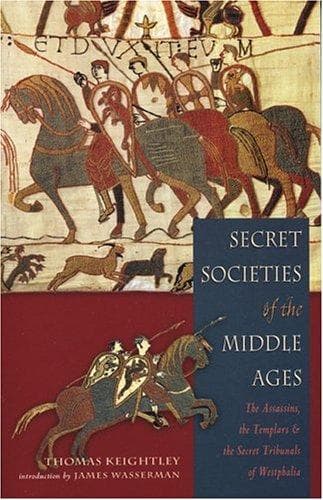
Secret Societies of the Middle AgesKeightley, Thomas
History
Secret Societies of the Middle Ages
Keightley, Thomas
Secret societies
[Footnote 104: Our readers will call to mind the well-known anecdote of
King Richard I. When admonished by the zealous Fulk, of Neuilly, to get
rid of his three favourite daughters, pride, avarice, and
voluptuousness,--"You counsel well," said the king, "and I hereby
dispose of the first to the Templars, of the second to the Benedictines,
and of the third to my prelates."]
[Footnote 105: Similar charges are said to have been brought against the
Hospitallers in the year 1238, but without effect. There was no Philip
the Fair at that time in France.]
[Footnote 106: Clement, in a bull dated but four days after that of the
suppression, acknowledged that the whole of the evidence against the
order amounted only to suspicion!]
We make little doubt that any one who coolly and candidly considers the
preceding account of the manner in which the order was suppressed will
readily concede that the guilt of its members was anything but proved.
It behoves their modern impugners to furnish some stronger proofs than
any they have as yet brought forward. The chief adversary of the
Templars at the present day is a writer whose veracity and love of
justice are beyond suspicion, and who has earned for himself enduring
fame by his labours in the field of oriental literature, but in whose
mind, as his most partial friends must allow, learning and imagination
are apt to overbalance judgment and philosophy[107]. He has been replied
to by Raynouard, Münter, and other able advocates of the knights.
[Footnote 107: We mean the illustrious Jos. von Hammer, whose essay on
the subject is to be found in the sixth volume of the Mines de l'Orient,
where it will be seen that he regards Sir W. Scott, in his Ivanhoe, as a
competent witness against the Templars, on account of his _correct and
faithful_ pictures of the manners and opinions of the middle ages. We
apprehend that people are beginning now to entertain somewhat different
ideas on the subject of our great romancer's fidelity, of which the
present pages present some instances.]
We now come to the question of the continuance of the order to the
present day. That it has in some sort been transmitted to our times is a
matter of no doubt; for, as we have just seen, the king of Portugal
formed the Order of Christ out of the Templars in his dominions. But our
readers are no doubt aware that the freemasons assert a connexion with
the Templars, and that there is a society calling themselves Templars,
whose chief seat is at Paris, and whose branches extend into England and
other countries. The account which they give of themselves is as
follows:--
Public-domain text, read in full here on John Shaqi.
Reviews
Reviews
No reviews yet
Be the first to share your thoughts on this work.
Elsewhere in the archive
Join the Discussion
Join the discussion
Sign in to leave a comment or review.
Sign InorCreate an account