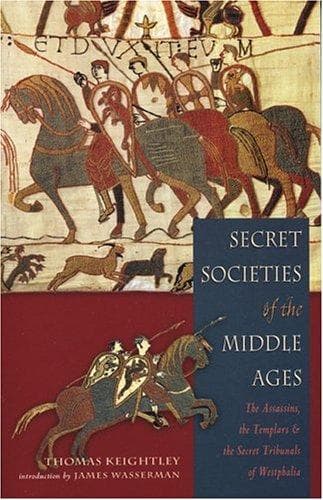
Secret Societies of the Middle AgesKeightley, Thomas
History
Secret Societies of the Middle Ages
Keightley, Thomas
Secret societies
James de Molay, in the year 1314, in anticipation of his speedy
martyrdom, appointed Johannes Marcus Lormenius to be his successor in
his dignity. This appointment was made by a regular well-authenticated
charter, bearing the signatures of the various chiefs of the order, and
it is still preserved at Paris, together with the statutes, archives,
banners, &c., of the soldiery of the Temple. There has been an unbroken
succession of grand-masters down to the present times, among whom are to
be found some of the most illustrious names in France. Bertrand du
Guesclin was grand-master for a number of years; the dignity was
sustained by several of the Montmorencies; and during the last century
the heads of the society were princes of the different branches of the
house of Bourbon. Bernard Raymond Fabré Palaprat is its head at present,
at least was so a few years ago[108].
[Footnote 108: See Manuel des Templiers. As this book is only sold to
members of the society, we have been unable to obtain a copy of it. Our
account has been derived from Mills's History of Chivalry. That this
writer should have believed it implicitly is, we apprehend, no proof of
its truth.]
This is no doubt a very plausible circumstantial account; but, on
applying the Ithuriel spear of criticism to it, various ugly shapes
resembling falsehood start up. Thus Molay, we are told, appointed his
successor in 1314. He was put to death on the 18th March of that year,
and the order had been abolished nearly a year before. Why then did he
delay so long, and why was he become so apprehensive of martyrdom at
that time, especially when, as is well known, there was then no
intention of putting him to death? Again, where were the chiefs of the
society at that time? How many of them were living? and how could they
manage to assemble in the dungeon of Molay and execute a formal
instrument! Moreover, was it not repugnant to the rules and customs of
the Templars for a Master to appoint his successor? These are a few of
the objections which we think may be justly made; and, on the whole, we
feel strongly disposed to reject the whole story.
Public-domain text, read in full here on John Shaqi.
Reviews
Reviews
No reviews yet
Be the first to share your thoughts on this work.
Elsewhere in the archive
Join the Discussion
Join the discussion
Sign in to leave a comment or review.
Sign InorCreate an account