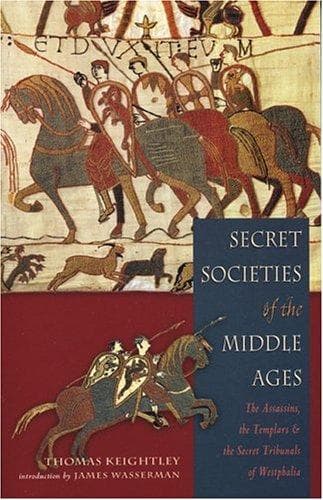
Secret Societies of the Middle AgesKeightley, Thomas
History
Secret Societies of the Middle Ages
Keightley, Thomas
Secret societies
[Footnote 111: The romantic accounts of the Secret Tribunals will be
found in Sir W. Scott's translation of Goëthe's Götz von Berlichingen,
and in his House of Aspen and Anne of Geierstein. From various passages
in Sir W. Scott's biographical and other essays, it is plain that he
believed such to be the true character of the Secret Tribunals.]
We fear that we cannot promise the full gratification of these
high-wrought expectations. Extraordinary as the Secret Tribunals really
were, we can only view them as an instance of that compensating
principle which may be discerned in the moral as well as in the natural
empire of the Deity; for, during the most turbulent and lawless period
of the history of Germany, almost the sole check on crime, in a large
portion of that country, was the salutary terror of these Fehm-Gerichte,
or Secret Tribunals. And those readers who have taken their notions of
them only from works of fiction will learn with surprise that no courts
of justice at the time exceeded, or perhaps we might say equalled, them
in the equity of their proceedings.
Unfortunately their history is involved in much obscurity, and we
cannot, as in the case of the two preceding societies, clearly trace
this association from its first formation to the time when it became
evanescent and faded from the view. While it flourished, the dread and
the fear of it weighed too heavily on the minds of men to allow them to
venture to pry into its mysteries. Certain and instantaneous death was
the portion of the stranger who was seen at any place where a tribunal
was sitting, or who dared so much as to look into the books which
contained the laws and ordinances of the society. Death was also the
portion of any member of the society who revealed its secrets; and so
strongly did this terror, or a principle of honour, operate, that, as
Æneas Sylvius (afterwards Pope Pius II.), the secretary of the Emperor
Frederick III., assures us, though the number of the members usually
exceeded 100,000, no motive had ever induced a single one to be
faithless to his trust. Still, however, sufficient materials are to be
found for satisfying all reasonable curiosity on the subject.
To ascertain the exact and legal sphere of the operation of this
formidable jurisdiction, and to point out its most probable origin, are
necessary preliminaries to an account of its constitution and its
proceedings. We shall therefore commence with the consideration of these
points.
Public-domain text, read in full here on John Shaqi.
Reviews
Reviews
No reviews yet
Be the first to share your thoughts on this work.
Elsewhere in the archive
Join the Discussion
Join the discussion
Sign in to leave a comment or review.
Sign InorCreate an account