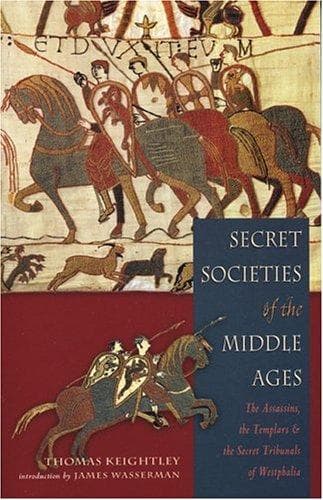
Secret Societies of the Middle AgesKeightley, Thomas
History
Secret Societies of the Middle Ages
Keightley, Thomas
Secret societies
Westphalia, then, was the birth-place of this institution, and over
Westphalia alone did it exercise authority. But the Westphalia of the
middle ages did not exactly correspond with that of the later times. In
a general sense it comprehended the country between the Rhine and the
Weser; its southern boundary was the mountains of Hesse; its northern,
the district of Friesland, which at that time extended from Holland to
Sleswig. In the records and law-books of the middle ages, this land
bears the mystic appellation of the _red earth_, a name derived, as one
writer thinks, from the _gules_, or red, which was the colour of the
field in the ducal shield of Saxony; another regards it as synonymous
with the _bloody earth_; and a third hints that it may owe its origin to
the _red_ colour of the soil in some districts of Westphalia.
This land formed a large portion of the country of the Saxons, who,
after a gallant resistance of thirty years, were forced to submit to
the sway of Charlemagne, and to embrace the religion of their conqueror.
The Saxons had hitherto lived in a state of rude independence, and their
dukes and princes possessed little or no civil power, being merely the
presidents in their assemblies and their leaders in war. Charlemagne
thought it advisable to abolish this dignity altogether, and he extended
to the country of the Saxons the French system of counts and counties.
Each count was merely a royal officer who exercised in the district over
which he was placed the civil and military authority. The _missi
dominici_ or _regii_ were despatched from the court to hold their
visitations in Saxony, as well as in the other dominions of Charles, and
at these persons of all classes might appear and prefer their complaints
to the representative of the king, if they thought themselves aggrieved
by the count or any of the inferior officers.
In the reign of Louis the German, the excellent institutions of
Charlemagne had begun to fall into desuetude; anarchy and violence had
greatly increased. The incursions of the Northmen had become most
formidable, and the Vends[112] also gave great disturbance to Germany.
The Saxon land being the part most immediately exposed to invasion, the
emperor resolved to revive the ancient dignity of dukes, and to place
the district under one head, who might direct the energies of the whole
people against the invaders. The duke was a royal lieutenant, like the
counts, only differing from them in the extent of the district over
which he exercised authority. The first duke of Saxony was Count Ludolf,
the founder of Gandersheim; on his death the dignity was conferred on
his son Bruno, who, being slain in the bloody battle of Ebsdorf fought
against the Northmen, was succeeded by his younger brother Otto, the
father of Henry the Fowler.
[Footnote 112: The Vends (_Wenden_) were a portion of the Slavonian race
who dwelt along the south coast of the Baltic.]
Public-domain text, read in full here on John Shaqi.
Reviews
Reviews
No reviews yet
Be the first to share your thoughts on this work.
Elsewhere in the archive
Join the Discussion
Join the discussion
Sign in to leave a comment or review.
Sign InorCreate an account