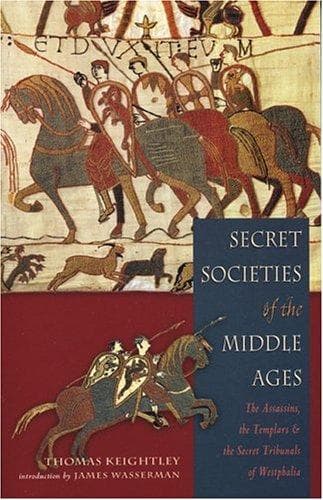
Secret Societies of the Middle AgesKeightley, Thomas
History
Secret Societies of the Middle Ages
Keightley, Thomas
Secret societies
Saxony was, however, afterwards restored by Conrad to Henry the Lion,
son of Henry the Proud, and Conrad's successor, Frederick Barbarossa,
gave him again Bavaria. Henry had himself carried his arms from the Elbe
to the Baltic, and conquered a considerable territory from the Vends,
which he regarded as his own peculiar principality. He was now master of
the greater part of Germany, and it was quite evident that he must
either obtain the imperial dignity or fall. His pride and his severity
made him many enemies; but as he had no child but a daughter, who was
married to a cousin of the emperor, his power was regarded without much
apprehension. It was, however, the ambition of Henry to be the father of
a race of heroes, and, after the fashion of those times, he divorced his
wife and espoused Matilda, daughter of Henry II. of England, by whom he
had four sons. Owing to this and other circumstances all friendly
feeling ceased between Henry and the emperor, whom, however, he
accompanied on the expedition to Italy, which terminated in the battle
of Legnano. But he suddenly drew off his forces and quitted the imperial
army on the way, and Frederick, imputing the ill success which he met
with in a great measure to the conduct of the Duke of Saxony, was, on
his return to Germany, in a mood to lend a ready ear to any charges
against him. These did not fail soon to pour in: the Saxon clergy, over
whom he had arrogated a right of investiture, appeared as his principal
accusers. Their charges, which were partly true, partly false, were
listened to by Frederick and the princes of the empire, and the downfall
of Henry was resolved upon. He was thrice summoned, but in vain, to
appear and answer the charges made against him. He was summoned a fourth
time, but to as little purpose; the sentence of outlawry was then
formally pronounced at Würtzburg. He denied the legality of the
sentence, and attempted to oppose its execution; several counts stood by
him in his resistance; but he was forced to submit and sue for grace at
Erfurt. The emperor pardoned him and permitted him to retain his
allodial property on condition of his leaving Germany for three years.
He was deprived of all his imperial fiefs, which were immediately
bestowed upon others.
Public-domain text, read in full here on John Shaqi.
Reviews
Reviews
No reviews yet
Be the first to share your thoughts on this work.
Elsewhere in the archive
Join the Discussion
Join the discussion
Sign in to leave a comment or review.
Sign InorCreate an account