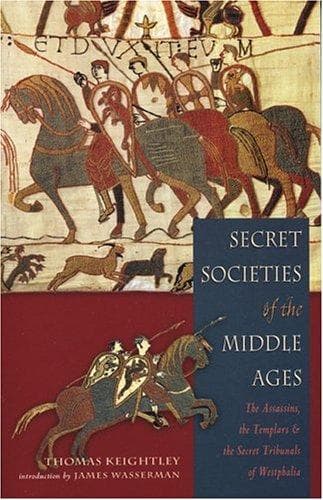
Secret Societies of the Middle AgesKeightley, Thomas
History
Secret Societies of the Middle Ages
Keightley, Thomas
Secret societies
On the failure of the German branch of the Carlovingians, the different
nations which composed the Germanic body appointed Conrad the Franconian
to be their supreme head; for a new enemy, the Magyars, or Hungarians,
now harassed the empire, and energy was demanded from its chief. Of this
Conrad himself was so convinced, that, when dying, after a short reign,
he recommended to the choice of the electors, not his own brother, but
Henry the Fowler, Duke of Saxony, who had, in his conflicts with the
Vends and the Northmen, given the strongest proofs of his talents and
valour. Henry was chosen, and the measures adopted by him during his
reign, and the defeat of the Hungarians, justified the act of his
elevation.
On the death of Henry, his son Otto, afterwards justly styled the Great,
was unanimously chosen to succeed him in the imperial dignity. Otto
conferred the Duchy of Saxony on Herman Billung. From their constant
warfare with the Vends and the Northmen, the Saxons were now esteemed
the most valiant nation in Germany, and they were naturally the most
favoured by the emperors of the house of Saxony. This line ending with
Henry II. in 1024, the sceptre passed to that of Franconia, under which
and the succeeding line of Suabia, owing to the contests with the popes
about investitures and to various other causes, the imperial power
greatly declined in Germany; anarchy and feuds prevailed to an alarming
extent; the castles of the nobles became dens of robbers; and law and
justice were nowhere to be found.
The most remarkable event of this disastrous period, and one closely
connected with our subject, is the outlawry of Henry the Lion, Duke of
Saxony and Bavaria. Magnus, the last of the Billungs of Saxony, died,
leaving only two daughters, of whom the eldest was married to Henry the
Black, Duke of Bavaria, who consequently had, according to the maxims of
that age, a right to the Duchy of Saxony; but the Emperor Henry V.
refused to admit his claim, and conferred it on Lothaire of Supplinburg.
As, however, Henry the Black's son, Henry the Proud, was married to the
only daughter of Lothaire, and this prince succeeded Henry V. in the
empire, Henry found no difficulty in obtaining the Duchy of Saxony from
his father-in-law, who also endeavoured to have him chosen his successor
in the imperial dignity. But the other princes were jealous of him, and
on the death of Lothaire they hastily elected Conrad of Suabia, who,
under the pretext that no duke should possess two duchies, called on
Henry to resign either Saxony or Bavaria. On his refusal, Conrad, in
conjunction with the princes of the empire, pronounced them both
forfeited, and conferred Bavaria on the Margraf of Austria, and Saxony
on Albert the Bear, the son of the second daughter of Duke Magnus of
Saxony.
Public-domain text, read in full here on John Shaqi.
Reviews
Reviews
No reviews yet
Be the first to share your thoughts on this work.
Elsewhere in the archive
Join the Discussion
Join the discussion
Sign in to leave a comment or review.
Sign InorCreate an account