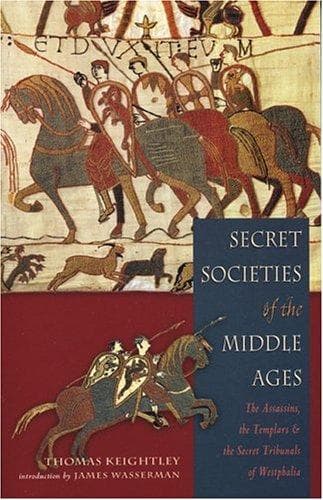
Secret Societies of the Middle AgesKeightley, Thomas
History
Secret Societies of the Middle Ages
Keightley, Thomas
Secret societies
Next to the count were the assessors or (_Schöppen_)[120]. These formed
the main body and strength of the society. They were nominated by the
count with the approbation of the tribunal-lord. Two persons, who were
already in the society, were obliged to vouch on oath for the fitness of
the candidate to be admitted. It was necessary that he should be a
German by birth; born in wedlock of free parents; of the Christian
religion; neither ex-communicate nor outlawed; not involved in any
Fehm-gericht process; a member of no spiritual order, &c.
[Footnote 120: This word, which cannot be adequately translated, is the
low-Latin _Scabini_, the French _Echevins_. We shall take the liberty of
using it throughout. The schöppen were called frei-(_free_) schöppen, as
the count was called _frei-graf_, the court _frei-stuhl_, on account of
the jurisdiction of the tribunals being confined to freemen.]
These schöppen were divided into two classes, the knightly, and the
simple, respectable assessors; for, as the maxim that every man should
be judged by his peers prevailed universally during the middle ages, it
was necessary to conform to it also in the Fehm-tribunals.
Previous to their admission to a knowledge of the secrets of the
society, the schöppen were named Ignorant; when they had been initiated
they were called Knowing (_Wissende_) or Fehmenotes. It was only these
last who were admitted to the secret-tribunal. The initiation of a
schöppe was attended with a good deal of ceremony. He appeared
bare-headed before the assembled tribunal, and was there questioned
respecting his qualifications. Then, kneeling down, with the thumb and
forefinger of his right hand on a naked sword and a halter, he
pronounced the following oath after the count:--
"I promise, on the holy marriage, that I will, from henceforth, aid,
keep, and conceal the holy Fehms, from wife and child, from father and
mother, from sister and brother, from fire and wind, from all that the
sun shines on and the rain covers, from all that is between sky and
ground, especially from the man who knows the law, and will bring before
this free tribunal, under which I sit, all that belongs to the secret
jurisdiction of the emperor, whether I know it to be true myself, or
have heard it from trustworthy people, whatever requires correction or
punishment, whatever is Fehm-free (_i. e._ a crime committed in the
county), that it may be judged, or, with the consent of the accuser, be
put off in grace; and will not cease so to do, for love or for fear, for
gold or for silver, or for precious stones; and will strengthen this
tribunal and jurisdiction with all my five senses and power; and that I
do not take on me this office for any other cause than for the sake of
right and justice; moreover, that I will ever further and honour this
free tribunal more than any other free tribunals; and what I thus
promise will I stedfastly and firmly keep, so help me God and his Holy
Gospel."
Public-domain text, read in full here on John Shaqi.
Reviews
Reviews
No reviews yet
Be the first to share your thoughts on this work.
Elsewhere in the archive
Join the Discussion
Join the discussion
Sign in to leave a comment or review.
Sign InorCreate an account