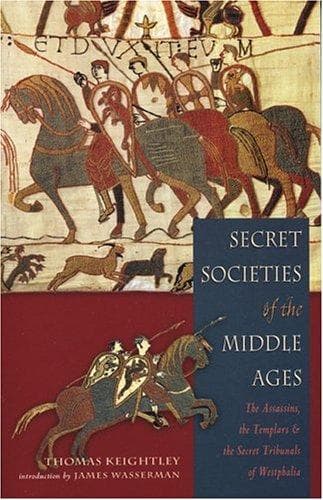
Secret Societies of the Middle AgesKeightley, Thomas
History
Secret Societies of the Middle Ages
Keightley, Thomas
Secret societies
He was further obliged to swear that he would ever, to the best of his
ability, enlarge the holy empire; and that he would undertake nothing
with unrighteous hand against the land and people of the stuhlherr.
The count then inquired of the officers of the court (the _Frohnboten_)
if the candidate had gone through all the formalities requisite to
reception, and when that officer had answered in the affirmative, the
count revealed to the aspirant the secrets of the tribunal, and
communicated to him the secret sign by which the initiated knew one
another. What this sign was is utterly unknown: some say that when they
met at table they used to turn the point of their knife to themselves,
and the haft away from them. Others take the letters S S G G, which were
found in an old MS. at Herford, to have been the sign, and interpret
them _Stock Stein, Gras Grein_. These are, however, the most arbitrary
conjectures, without a shadow of proof. The count then was bound to
enter the name of the new member in his register, and henceforth he was
one of the powerful body of the initiated.
Princes and nobles were anxious to have their chancellors and ministers,
corporate towns to have their magistrates, among the initiated. Many
princes sought to be themselves members of this formidable association,
and we are assured that in the fourteenth and fifteenth centuries (which
are the only ones of which we have any particular accounts) the number
of the initiated exceeded 100,000.
The duty of the initiated was to go through the country to serve
citations and to trace out and denounce evil-doers; or, if they caught
them in the fact, to execute instant justice upon them. They were also
the count's assessors when the tribunal sat. For that purpose seven at
least were required to be present, all belonging to the county in which
the court was held; those belonging to other counties might attend, but
they could not act as assessors; they only formed a part of the
by-standers of the court. Of these there were frequently some hundreds
present.
Public-domain text, read in full here on John Shaqi.
Reviews
Reviews
No reviews yet
Be the first to share your thoughts on this work.
Elsewhere in the archive
Join the Discussion
Join the discussion
Sign in to leave a comment or review.
Sign InorCreate an account