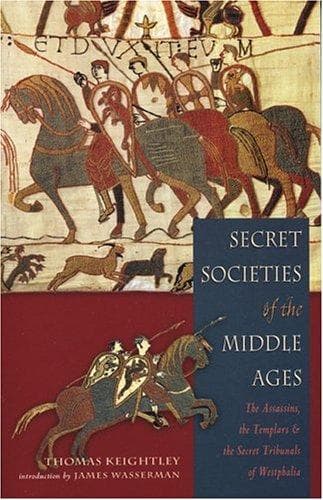
Secret Societies of the Middle AgesKeightley, Thomas
History
Secret Societies of the Middle Ages
Keightley, Thomas
Secret societies
When the count held the Secret Court, the clergy, who had received the
tonsure and ordination, women and children, Jews and Heathens[123], and,
as it would appear, the higher nobility, were exempted from its
jurisdiction. The clergy were exempted, probably, from prudential
motives, as it was not deemed safe to irritate the members of so
powerful a body, by encroaching on their privileges; they might,
however, voluntarily subject themselves to the Fehm-gerichte if they
were desirous of partaking of the advantages of initiation. Women and
children were exempt on account of their sex and age, and the period of
infancy was extended, in the citations, to fourteen, eighteen, and
sometimes twenty years of age. Jews, Heathens, and such like, were
exempted on account of their unworthiness. The higher nobility were
exempted (if such was really the case) in compliance with the maxim of
German law that each person should be judged by his peers, as it was
scarcely possible that in any county there could be found a count and
seven assessors of equal rank with accused persons of that class.
[Footnote 123: The natives of Prussia were still heathens at that time.]
In their original constitution the Fehm-gerichte, agreeably to the
derivation of the name from _Fem_, condemnation, were purely criminal
courts, and had no jurisdiction in civil matters. They took cognizance
of all offences against the Christian faith, the holy gospel, the holy
ten commandments, the public peace, and private honour--a category,
however, which might easily be made to include almost every
transgression and crime that could be committed. We accordingly find in
the laws of the Fehm-gerichte, sacrilege, robbery, rape, murder,
apostacy, treason, perjury, coining, &c., &c., enumerated; and the
courts, by an astute interpretation of the law, eventually managed to
make matters which had not even the most remote appearance of
criminality _Fehmbar_, or within their jurisdiction.
But all exceptions were disregarded in cases of contumacy, or of a
person being taken in the actual commission of an offence. When a
person, after being duly cited, even in a civil case, did not appear to
answer the charge against him, he was outlawed, and his offence became
_fehmbar_; every judge was then authorized to seize the accused, whether
he belonged to his county or not; the whole force of the initiated was
now directed against him, and escape was hardly possible. Here it was
that the superior power of the Fehm-gerichte exhibited itself. Other
courts could outlaw as well as they, but no other had the same means of
putting its sentences into execution. The only remedy which remained for
the accused was to offer to appear and defend his cause, or to sue to
the emperor for protection. In cases where a person was caught
_flagranti delicto_, the Westphalian tribunals were competent to
proceed to instant punishment.
Public-domain text, read in full here on John Shaqi.
Reviews
Reviews
No reviews yet
Be the first to share your thoughts on this work.
Elsewhere in the archive
Join the Discussion
Join the discussion
Sign in to leave a comment or review.
Sign InorCreate an account