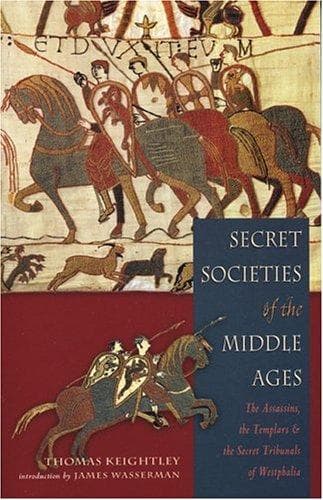
Secret Societies of the Middle AgesKeightley, Thomas
History
Secret Societies of the Middle Ages
Keightley, Thomas
Secret societies
All the initiated of every degree might go on foot and on horseback
through the country, for daring was the man who would presume to injure
them, as certain death was his inevitable lot. A dreadful punishment
also awaited any one of them who should forget his vow and reveal the
secrets of the society; he was to be seized, a cloth bound over his
eyes, his hands tied behind his back, a halter put about his neck; he
was to be thrown upon his belly, his tongue pulled out behind by the
nape of his neck, and he was then to be hung seven feet higher than any
other felon. It is doubtful, however, if there ever was a necessity for
inflicting this punishment, for Æneas Sylvius, who wrote at the time
when the society had degenerated, assures us that no member had ever
been induced, by any motives whatever, to betray its secrets; and he
describes the initiated as grave men and lovers of right and justice.
Similar language is employed concerning them by other writers of the
time.
Besides the count and the assessors, there were required, for the due
holding a Fehm-court, the officers named _Frohnboten_[121], or
serjeants, or messengers, and a clerk to enter the decisions in what was
called the blood-book (_Liber sanguinis_). These were, of course,
initiated, or they could not be present. It was required that the
messengers should be freemen belonging to the county, and have all the
qualifications of the simple schöppen. Their duty was to attend on the
court when sitting, and to take care that the ignorant, against whom
there was any charge, were duly cited[122].
[Footnote 121: _Frohnbote_ is interpreted a _Holy Messenger_, or a
_Servant of God_.]
[Footnote 122: When a person was admitted into the society he paid,
besides the fee to the count already mentioned, to each schöppe who was
assisting there, and to each frohnbote, four livres Tournois.]
The count was to hold two kinds of courts, the one public, named the
Open or Public Court (_Offenbare Ding_), to which every freeman had
access; the other private, called the Secret Tribunal (_Heimliche
Acht_), at which no one who was not initiated could venture to appear.
The former court was held at stated periods, and at least three times in
each year. It was announced fourteen days previously by the messengers
(_Frohnboten_), and every householder in the county, whether initiated
or not, free or servile, was bound under a penalty of four heavy
shillings, to appear at it and declare on oath what crimes he knew to
have been committed in the county.
Public-domain text, read in full here on John Shaqi.
Reviews
Reviews
No reviews yet
Be the first to share your thoughts on this work.
Elsewhere in the archive
Join the Discussion
Join the discussion
Sign in to leave a comment or review.
Sign InorCreate an account