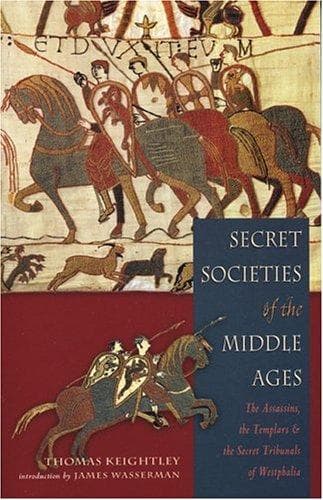
Secret Societies of the Middle AgesKeightley, Thomas
History
Secret Societies of the Middle Ages
Keightley, Thomas
Secret societies
The Fehm-courts (like the German courts in general) were holden on a
Tuesday[125]. If on this day the accused, or his attorney, appeared at
the appointed place, and no court was holden, the summons abated or lost
its force; the same was the case when admission was refused to him and
his suite, a circumstance which sometimes occurred. But should he not
appear to the first summons, he was fined the first time thirty
shillings, the second time sixty, the third time he was _forfehmed_. The
court had however the power of granting a further respite of six weeks
and three days previous to passing this last severe sentence. This term
of grace was called the King's Dag, or the Emperor Charles's Day of
Grace.
[Footnote 125: In German, _Dienstag_, probably _Dinstag_, i.e.
_Court-day_.]
The plea of necessary and unavoidable absence was, however, admitted in
all cases, and the Fehm-law distinctly recognised four legal impediments
to appearance, namely, imprisonment, sickness, the service of God (that
is, pilgrimage), and the public service. The law also justly added the
following cases:--inability to cross a river for want of a bridge or a
boat, or on account of a storm; the loss of his horse when the accused
was riding to the court, so that he could not arrive in time; absence
from the country on knightly, mercantile, or other honest occasions; and
lastly, the service of his lord or master. In short, any just excuse was
admitted. As long as the impediment continued in operation all
proceedings against the accused were void. If the impediment arose from
his being in prison, or in the public service, or that of his master, he
was to notify the same by letter sealed with his seal, or else by his
own oath and those of two or three other persons. The other impediments
above enumerated were to be sworn to by himself alone.
If the accused neglected answering the two first summonses, but appeared
to the third, he was required to pay the two fines for non-appearance;
but if he declared himself too poor to pay them, he was obliged to place
his two fore-fingers on the naked sword which lay before the court, and
swear, _by the death which God endured on the cross_, that such was the
case. It was then remitted to him, and the court proceeded to his trial.
Public-domain text, read in full here on John Shaqi.
Reviews
Reviews
No reviews yet
Be the first to share your thoughts on this work.
Elsewhere in the archive
Join the Discussion
Join the discussion
Sign in to leave a comment or review.
Sign InorCreate an account