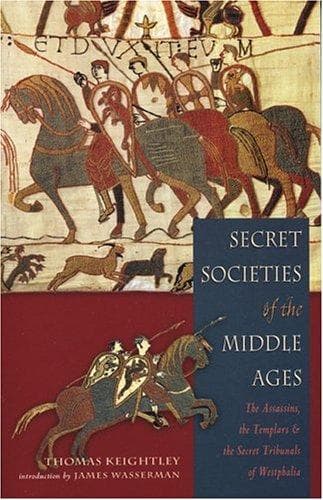
Secret Societies of the Middle AgesKeightley, Thomas
History
Secret Societies of the Middle Ages
Keightley, Thomas
Secret societies
When a Fehm-court sat the count presided; before him lay on the table a
naked sword and a withy-halter; the former, says the law, signifying the
cross on which Christ suffered and the rigour of the court, the latter
denoting the punishment of evil-doers, whereby the wrath of God is
appeased. On his right and left stood the clerks of the court, the
assessors, and the audience. All were bare-headed, to signify, says the
law, that they would proceed openly and fairly, punish men only for the
crimes which they had committed, and _cover no right with unright_. They
were also to have their hands uncovered to signify that they would do
nothing covertly and underhand. They were to have short cloaks on their
shoulders, significatory of the warm love which they should have for
justice; _for as the cloak covers all the other clothes and the body, so
should their love cover justice_. They were to wear neither weapons nor
harness, that no one might feel any fear of them, and to indicate that
they were under the peace of the emperor, king, or empire. Finally, they
were to be free from wrath and sober, that drunkenness might not lead
them to pass unrighteous judgment, _for drunkenness causes much
wickedness_.
If one who was not initiated was detected in the assembly, his process
was a brief one. He was seized without any ceremony, his hands and feet
were tied together, and he was hung on the next tree. Should a
noth-schöppe be caught in the assembly, a halter of oaken twigs was put
about his neck, and he was thrown for nine days into a dark dungeon, at
the end of which time he was brought to trial, and, if he failed in
clearing himself, he was proceeded with according to law, that is, was
hanged.
The business of the day commenced, as in German courts in general, by
the count asking of the messengers if it was the day and time for
holding a court under the royal authority. An affirmative answer being
given, the count then asked how many assessors should there be on the
tribunal, and how the seat should be filled. When these questions were
answered, he proclaimed the holding of the court.
Public-domain text, read in full here on John Shaqi.
Reviews
Reviews
No reviews yet
Be the first to share your thoughts on this work.
Elsewhere in the archive
Join the Discussion
Join the discussion
Sign in to leave a comment or review.
Sign InorCreate an account