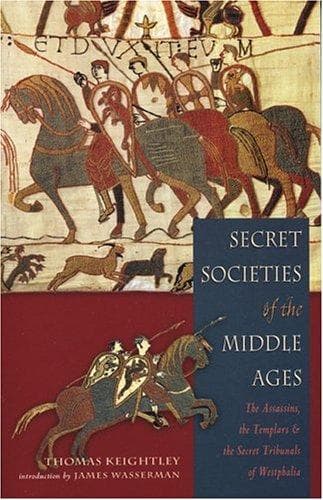
Secret Societies of the Middle AgesKeightley, Thomas
History
Secret Societies of the Middle Ages
Keightley, Thomas
Secret societies
The older Fehm-law made a great distinction between the initiated and
the ignorant, and one very much to the advantage of the former. The
accused, if initiated, was allowed to clear himself from the charge by
laying his two fore-fingers on the naked sword, and swearing by the
saints "that he was innocent of the things and the deed which the court
had mentioned to him, and which the accuser charged him with, so help
him God and all the saints." He then threw a cross-penny (Kreutzer?) to
the court and went his way, no one being permitted to let or hinder him.
But if he was one of the uninitiated, he was not permitted to clear
himself in this manner, and the truth of the fact was determined by the
evidence given.
It is plain, however, that such a regulation as this could properly only
belong to the time when none but persons of irreproachable character
were initiated. As the institution degenerated, this distinction was
gradually lost sight of, and facts were determined by evidence without
any regard to the rank of the accused.
The accuser could prevent the accused from clearing himself thus easily,
by offering himself and six compurgators to swear to the truth of his
charge. If the accused wanted to outweigh this evidence, he was obliged
to come forward with thirteen or twenty compurgators and swear to his
innocence. If he could bring the last number he was acquitted, for the
law did not allow it to be exceeded; but if he had but thirteen, the
accuser might then overpower him by bringing forward twenty to vouch for
his veracity.
If the accuser had convicted the accused, he forthwith prayed the count
to grant him a just sentence. The count never took on himself the office
of finding the verdict; he always directed one of the assessors to
perform it. If the assessor thought the matter too difficult for his
judgment, he averred on oath that such was the case, and the court then
gave the duty to another, who might free himself from the responsibility
in the same manner. Should none of the assessors be able to come to a
decision, the matter was put off till the next court-day.
But if the assessor undertook the finding of the verdict, it lay with
himself whether he should do so alone, or retire to take the opinion of
the other assessors and the by-standers. To give the verdict due force
it must be found sitting, otherwise it might be objected to. Whether or
not the assessor was bound to decide according to the majority of voices
is uncertain. When the verdict had been found the assessor appeared with
his colleagues before the tribunal, and delivered it to the count, who
then passed sentence. What, the penalties were for different offences
was a secret known only to the initiated; but, if they were of a capital
nature, the halter, as was intimated by the one which lay before the
count, was the instrument of punishment.
Public-domain text, read in full here on John Shaqi.
Reviews
Reviews
No reviews yet
Be the first to share your thoughts on this work.
Elsewhere in the archive
Join the Discussion
Join the discussion
Sign in to leave a comment or review.
Sign InorCreate an account