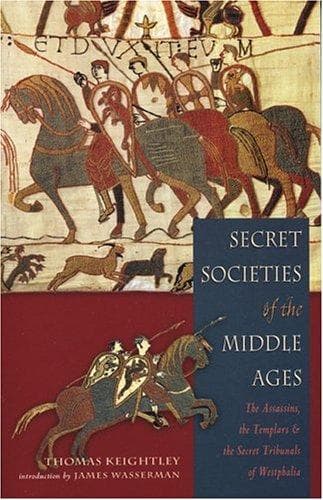
Secret Societies of the Middle AgesKeightley, Thomas
History
Secret Societies of the Middle Ages
Keightley, Thomas
Secret societies
Each party was permitted to bring with him as many as thirty friends to
act as witnesses and compurgators. Lest, however, they might attempt to
impede the course of justice, they were required to appear unarmed. Each
party had, moreover, the right of being represented by his attorney. The
person so employed must be initiated; he must also be the peer of the
party, and if he had been engaged on either side he could not, during
any stage of the action, be employed on the other, even with the
permission of the party which had just engaged him. When he presented
himself before the court, his credentials were carefully examined, and
if found strictly conformable to what the law had enjoined, they were
declared valid. It was necessary that they should have been written on
good, new, and sound parchment, without blot or erasure, and be sealed
by the seals of at least two frei-schöppen.
The attorney of a prince of the empire appeared with a green cross in
his right hand, and a golden penny of the empire in his left. He was
also to have a glove on his right hand. If there were two attorneys,
they were both to bear crosses and pence. The attorney of a simple
prince bore a silver penny. The old law, which loves to give a reason
for every thing, says, "By the cross they intimate that the prince whom
they represent will, in case he should be found guilty, amend his
conduct according to the direction of the faith which Jesus Christ
preached, and be constant and true to the holy Christian faith, and
obedient to the holy empire and justice."
All the preliminaries being arranged, the trial commenced by the charge
against him being made known to the accused, who was called upon for his
defence. If he did not wish to defend himself in person, he was
permitted to employ an advocate whom he might have brought with him. If
it was a civil suit, he might, however, stay the proceedings at once by
giving good security for his satisfying the claims of the plaintiff, in
which case he was allowed the usual grace of six weeks and three days.
He might also except to the competence of the court, or to the legality
of the summons, or to anything else which would, if defective, annul the
proceedings.
If the accused did not appear, the regular course was for the prosecutor
to _overswear_ him; that is, himself to swear by the saints to the truth
of what he had stated, and six true and genuine frei-schöppen to swear
that they believed him to have spoken the truth.
Public-domain text, read in full here on John Shaqi.
Reviews
Reviews
No reviews yet
Be the first to share your thoughts on this work.
Elsewhere in the archive
Join the Discussion
Join the discussion
Sign in to leave a comment or review.
Sign InorCreate an account