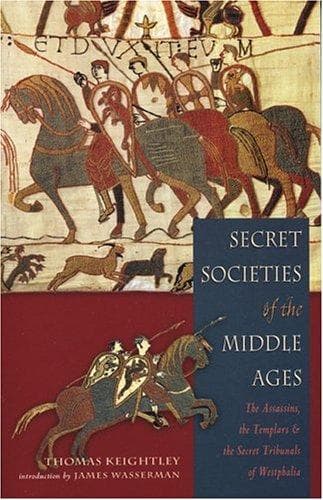
Secret Societies of the Middle AgesKeightley, Thomas
History
Secret Societies of the Middle Ages
Keightley, Thomas
Secret societies
The similarity between the Fehm-courts and the Inquisition has been
often observed. In the secrecy of their proceedings, and the great
number of agents which they had at their devotion, they resemble each
other; but the Holy Office had nothing to correspond to the public and
repeated citations of the Fehm-courts, the fair trial given to the
accused, the leaning towards mercy of the judges, and the right of
appeal which was secured.
The most remarkable resemblance to the Fehm-tribunals is (or was) to be
found among the negroes on the west coast of Africa, as they are
described by a French traveller[129]. These are the Purrahs of the
Foollahs, who dwell between Sierra Leone river and Cape Monte.
[Footnote 129: Golberry, Voyage en Afrique, t. i. p. 114, and seq.]
There are five tribes of this people, who form a confederation, at the
head of which is a union of warriors, which is called a Purrah. Each
tribe has its own separate Purrah, and each Purrah has its chiefs and
its tribunal, which is, in a more restricted sense, also called a
Purrah. The general Purrah of the confederation is formed from the
Purrahs of the five tribes.
To be a member of the inferior Purrahs, a man must be thirty years of
age; no one under fifty can have a seat in the general Purrah. The
candidate for admission into an inferior Purrah has to undergo a most
severe course of probation, in which all the elements are employed to
try him. Before he is permitted to enter on this course, such of his
relatives as are already members are obliged to pledge themselves for
his fitness, and to swear to take his life if ever he should betray the
secrets of the society. Having passed through the ordeal, he is admitted
into the society and sworn to secrecy and obedience. If he is unmindful
of his oath, he becomes the child of death. When he least expects it a
warrior in disguise makes his appearance and says, "The great Purrah
sends thee death." Every one present departs; no one ventures to make
any opposition, and the victim falls.
The subordinate Purrahs punish all crimes committed within their
district, and take care that their sentences are duly executed. They
also settle disputes and quarrels between the leading families.
Public-domain text, read in full here on John Shaqi.
Reviews
Reviews
No reviews yet
Be the first to share your thoughts on this work.
Elsewhere in the archive
Join the Discussion
Join the discussion
Sign in to leave a comment or review.
Sign InorCreate an account