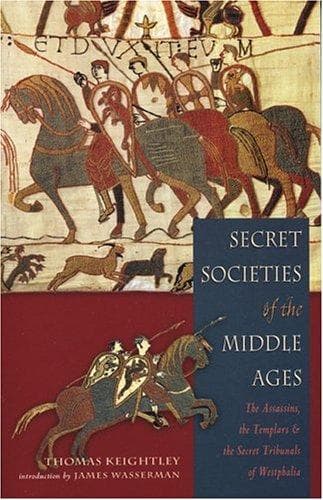
Secret Societies of the Middle AgesKeightley, Thomas
History
Secret Societies of the Middle Ages
Keightley, Thomas
Secret societies
It is only on extraordinary occasions that the great Purrah meets. It
then decides on the punishment of traitors and those who had resisted
its decrees. Frequently too it has to interfere to put an end to wars
between the tribes. When it has met on this account it gives information
to the belligerents, directing them to abstain from hostilities, and
menacing death if a drop more of blood should be spilt. It then inquires
into the causes of the war, and condemns the tribe which is found to
have been the aggressor to a four days' plundering. The warriors to whom
the execution of this sentence is committed must, however, be selected
from a neutral district. They arm and disguise themselves, put
horrible-looking vizards on their faces, and with pitch-torches in their
hands set out by night from the place of assembly. Making no delay, they
reach the devoted district before the break of day, and in parties of
from forty to sixty men, they fall unexpectedly on the devoted tribe,
and, with fearful cries, making known the sentence of the great Purrah,
proceed to put it into execution. The booty is then divided: one half is
given to the injured tribe, the other falls to the great Purrah, who
bestow one half of their share on the warriors who executed their
sentence.
Even a single family, if its power should appear to be increasing so
fast as to put the society in fear for its independence, is condemned to
a plundering by the Purrah. It was thus, though under more specious
pretexts, that the Athenian democracy sought to reduce the power of
their great citizens by condemning them to build ships, give theatrical
exhibitions, and otherwise spend their fortunes.
Nothing can exceed the dread which the Purrah inspires. The people speak
of it with terror and awe, and look upon the members of it as enchanters
who are in compact with the devil. The Purrah itself is solicitous to
diffuse this notion as much as possible, esteeming it a good mean for
increasing its power and influence. The number of its members is
estimated at upwards of 6000, who recognise each other by certain words
and signs. Its laws and secrets are, notwithstanding the great number of
the members, most religiously concealed from the knowledge of the
uninitiated.
CHAPTER VI.
The Emperor Lewis the Bavarian--Charles IV.--Wenceslaus--Rupertian
Reformation--Encroachments of the Fehm-courts--Case of Nickel
Weller and the town of Görlitz--Of the City of Dantzig--Of Hans
David and the Teutonic Knights--Other instances of the presumption
of the Free-counts--Citation of the Emperor Frederic III.--Case of
the Count of Teckenburg.
Public-domain text, read in full here on John Shaqi.
Reviews
Reviews
No reviews yet
Be the first to share your thoughts on this work.
Elsewhere in the archive
Join the Discussion
Join the discussion
Sign in to leave a comment or review.
Sign InorCreate an account