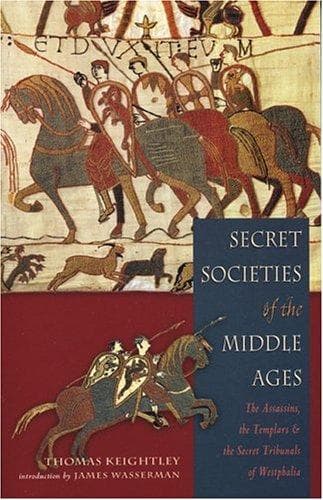
Secret Societies of the Middle AgesKeightley, Thomas
History
Secret Societies of the Middle Ages
Keightley, Thomas
Secret societies
Weller immediately repaired to Bresslau, and besought the council, the
Bishop of Waradein, and the imperial chancellor, to advocate his cause.
They acceded to his desire; but the magistrates of Görlitz perfectly
justified their conduct. Weller, still indisposed to rest, applied to
the pope, Innocent VIII., asserting that he could not to any purpose
bring an accusation against the council of Görlitz within the town of
the diocese of Meissen, and that he had no chance of justice there. The
pope forthwith named John de' Medici and Dr. Nicholas Tauchen of
Bresslau spiritual commissioners in this affair, and these desired the
high-bailiff of Stein to do his best that Weller should recover his
rights within the space of a month, on his taking his oath to the truth
of his statements, otherwise they should be obliged themselves to take
measures for that purpose.
From some unassigned cause, however, nothing came of this, and Weller
once more addressed himself to the pope, with whom the Bishop of Ostia
became his advocate. He was re-admitted into the bosom of the Church;
but the decree of the magistracy of Görlitz still remained in force, and
the new commissioners appointed by the pope even confirmed it.
Finding that he had nothing to expect from papal interference, Weller
had at last recourse to the Fehm-tribunals, and on the 3d May, 1490,
John of Hulschede, count of the tribunal at Brackel, cited the
burgomasters, council, and all the lay inhabitants of Görlitz above the
age of eighteen years, before his tribunal. This summons was served in
rather a remarkable manner, for it was found fastened to a twig on a
hedge, on a farm belonging to a man named Wenzel Emmerich, a little
distance from the town.
As by the Golden Bull of the Emperor Charles IV., and moreover by a
special privilege granted by Sigismund, Görlitz was exempted from all
foreign jurisdiction, the magistracy informed Vladislaus, King of
Bohemia, of this citation, and implored his mediation. The Bohemian
monarch accordingly addressed himself to the tribunal at Brackel, but
George Hackenberg, who was at that time the free-count of that court,
Hulschede being dead, did not even deign to give him an answer.
Public-domain text, read in full here on John Shaqi.
Reviews
Reviews
No reviews yet
Be the first to share your thoughts on this work.
Elsewhere in the archive
Join the Discussion
Join the discussion
Sign in to leave a comment or review.
Sign InorCreate an account