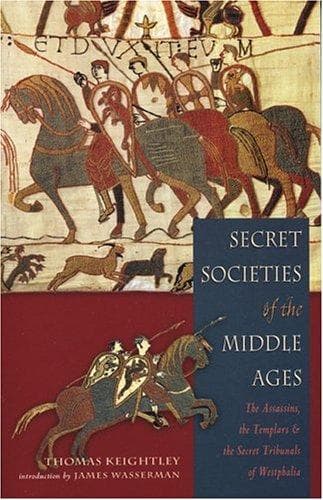
Secret Societies of the Middle AgesKeightley, Thomas
History
Secret Societies of the Middle Ages
Keightley, Thomas
Secret societies
The Rupertian reformation, and the establishment of the office of
lieutenant in the person of the Archbishop of Cologne, which was
completed by either Rupert or his successor Sigismund, form together an
epoch in the history of the Fehm-gerichte. Hitherto Westphalia alone was
the scene of their operations, and their authority was of evident
advantage to the empire. Their power had now attained its zenith;
confidence in their strength led them to abuse it; and, during the
century which elapsed between the Rupertian reformation and the
establishment of the Perpetual Public Peace and the Imperial Chamber by
the Emperor Maximilian, we shall have to contemplate chiefly their
abuses and assumptions.
The right of citation was what was chiefly abused by the Free-courts.
Now that they were so formally acknowledged to act under the imperial
authority, they began to regard Westphalia as too narrow a theatre for
the display of their activity and their power. As imperial
commissioners, they maintained that their jurisdiction extended to every
place which acknowledged that of the emperor's, and there was hardly a
corner of Germany free from the visits of their messengers; nay, even
beyond the limits of the empire men trembled at their citations.
It was chiefly the towns which were harassed by these citations, which
were frequently issued at the instance of persons whom they had punished
or expelled for their misdeeds. Their power and consequence did not
protect even the greatest: we find, during the fifteenth century, some
of the principal cities of the empire summoned before the tribunals of
Westphalian counts. Thus in the records of those times we read of
citations served on Bremen, Lübeck, Augsburg, Nuremberg, Erfurt,
Görlitz, and Dantzig. Even Prussia and Livonia, then belonging to the
order of the Teutonic knights, were annoyed by their interference.
One of the most remarkable cases which this period presents is that of
the uneasiness caused to the town of Görlitz by means of one of its
inhabitants named Nickel Weller. This man, who was a Westphalian
schöppe, was accused of having disinterred an unchristened child, and of
having made a candle of the bone of its arm, which he had filled with
the wax of an Easter-taper and with incense, and of having employed it
in a barn in presence of his mother, his wife, and an old peasant, for
magical purposes. As he could not deny the fact, he was, according to
the law of those times, liable to be hanged; but the high-bailiff of
Stein, and some other persons of consequence, interfering in his favour,
the magistrates contented themselves with expelling him from the town
and confiscating his goods. As it afterwards proved, they would have
acted more wisely had they condemned him to perpetual imprisonment.
Public-domain text, read in full here on John Shaqi.
Reviews
Reviews
No reviews yet
Be the first to share your thoughts on this work.
Elsewhere in the archive
Join the Discussion
Join the discussion
Sign in to leave a comment or review.
Sign InorCreate an account