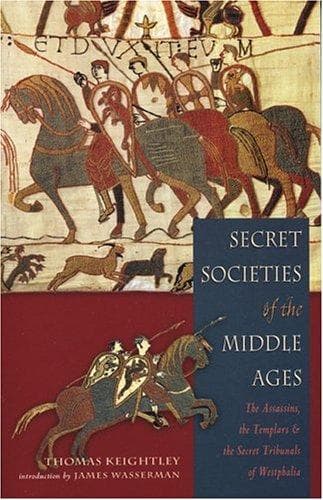
Secret Societies of the Middle AgesKeightley, Thomas
History
Secret Societies of the Middle Ages
Keightley, Thomas
Secret societies
The two towns of Görlitz and Bresslau held a consultation at Liegnitz,
to devise what measures it were best to adopt in order to relieve
themselves from this system of persecution. They resolved that they
would jointly and separately defend themselves and their proceedings by
a public declaration, which should be posted up in Görlitz, Bresslau,
Leipzig, and other places. They also resolved to lay their griefs before
the Diet at Prague, and pray for its intercession with the Archbishop of
Cologne and the Landgraf of Hessen. They accordingly did so, and the
Diet assented to their desire; but their good offices were of no avail,
and the answer of the landgraf clearly showed, either that he had no
authority over his count, or that he was secretly pleased with what he
had done.
The indefatigable Weller now endeavoured to seize some of the people of
Bresslau and Görlitz, in Hein and other places in Meissen. But they
frustrated his plans by obtaining a promise of protection and
safe-conduct from the Duke George. Weller, however, did not desist, and
when Duke Albert came from the Netherlands to Meissen, he sought and
obtained his protection. But here again he was foiled; for, when the
high-bailiff and council of Görlitz had informed that prince of the real
state of the case, he withdrew his countenance from him. Wearied out by
this ceaseless teasing, the towns applied, through the king of Bohemia,
to the Emperor Frederic III. for a mandate to all the subjects of the
empire, and an inhibition to the tribunal at Brackel and all the
free-counts and schöppen. These, when obtained, they took care to have
secretly served on the council of Dortmund and the free-count of
Brackel. By these means they appear to have put an end to their
annoyances for the remainder of Weller's life. But, in the year 1502,
his son and his son-in-law revived his claims on Görlitz. Count Ernest
of Hohenstein interceded for them; but the council adhered firmly to
their previous resolution, and declared that it was only to their own or
to higher tribunals that they must look for relief. The matter then lay
over for ten years, when it was again stirred by one Guy of Taubenheim,
and was eventually settled by an amicable arrangement.
As we have said, the Fehm-tribunals extended their claims of
jurisdiction even to the Baltic. We find that a citizen of the town of
Dantzig, named Hans Holloger, who was a free schöppe, was cited to
appear before the tribunal of Elleringhausen, under the hawthorn,
"because he had spoken what he ought not to have spoken about the Secret
Tribunal." This might seem just enough, as he belonged to the society;
but the town-council were commanded, under a penalty of fifty pounds of
fine gold, to cast the accused into prison till he had given security
for standing his trial.
Public-domain text, read in full here on John Shaqi.
Reviews
Reviews
No reviews yet
Be the first to share your thoughts on this work.
Elsewhere in the archive
Join the Discussion
Join the discussion
Sign in to leave a comment or review.
Sign InorCreate an account