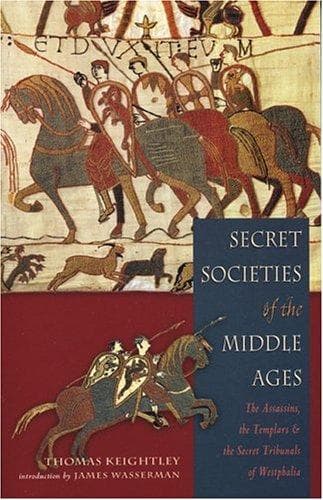
Secret Societies of the Middle AgesKeightley, Thomas
History
Secret Societies of the Middle Ages
Keightley, Thomas
Secret societies
Even the powerful order of the Teutonic Knights, who were the masters of
Prussia and Livonia, did not escape being annoyed by the Fehm-tribunals.
How little their power availed against that formidable jurisdiction is
evinced by the answer made by the Grand Master to the towns which sued
to him for protection. "Beloved liegemen! you have besought us to
protect you therefrom; we would cheerfully do it knew we but ways and
means thereto." And when he wrote to Mangolt, the count of the tribunal
at Freyenhagen, warning him against summoning before him the subjects of
the order, the latter haughtily replied, "You have your rights from the
empire, and I have power to judge over all who hold of the empire."
The following very curious case occurred in the first half of the
fifteenth century:--
A shopkeeper at Liebstadt died very much indebted to the two officers of
the Teutonic order, whose business it was to keep the small towns in
Prussia supplied with mercantile goods, and they accordingly seized on
the effects which he had left behind him. These, however, were not
sufficient to satisfy even the demands of one of them, much less of
both, and they had made up their minds to rest content with the loss,
when, to their surprise, Hans David, the son of the deceased, came
forward with an account against the order of such amount, that, as it
was observed, if all the houses in the town were sold, and all the
townsmen taxed to the utmost, the produce would not discharge the
one-half of it. He however produced a document purporting to be a bond
of the order. This instrument bore all the marks of falsification; it
was full of erasures and insertions; among the witnesses to it, some
were set down as priors who were only simple brethren of the order;
there were the names of others who had never seen it; it was asserted to
have been attested and verified by the tribunal at Passnar, but in the
records of that court there were not the slightest traces of it; the
seal of the Grand Master, which was appended to every document of any
importance, was wanting. Of course payment was resisted, but Hans David
was told to pursue his claim, if he pleased, before the emperor and the
pope, whom the order recognised as their superiors.
As Hans David was under the protection of the king of Poland, he had
recourse to that prince; but he declined interfering any farther than to
apply for a safe-conduct for him that he might apply for a new inquiry.
The Grand Master, on application being made to him, swore on his honour
that he owed to the complainant nothing, and that the bond was a
forgery; he moreover promised to answer the charge in any fit place that
the complainant might select; nay, even in Prussia, and he granted him a
safe-conduct as before.
Public-domain text, read in full here on John Shaqi.
Reviews
Reviews
No reviews yet
Be the first to share your thoughts on this work.
Elsewhere in the archive
Join the Discussion
Join the discussion
Sign in to leave a comment or review.
Sign InorCreate an account