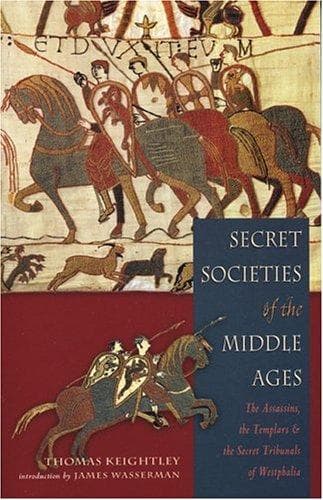
Secret Societies of the Middle AgesKeightley, Thomas
History
Secret Societies of the Middle Ages
Keightley, Thomas
Secret societies
Still the unwearied Hans David did not rest. He now went to the
Free-tribunal at Waldeck, and had the art to deceive the count by his
false representations. He assured him that the order had offered him no
less than 15,000 florins and an annuity, if he would let his action
drop; that they would have been extremely well content if he had escaped
out of prison at Cologne, but that he preferred justice and truth to
liberty. The order however succeeded here again in detecting and
exposing his arts, and the count honestly confessed that he had been
deceived by him. He cast him off forthwith, and Hans David, ceasing to
annoy the order, devoted himself to astrology and conjuring for the rest
of his days[130].
[Footnote 130: The following is one of his predictions, delivered by
him, under the name of Master Von Dolete, in the year 1457: "In the
ensuing month, September, the sun will appear like a black dragon; cruel
winds will blow, the sea will roar, and men will be knocked to pieces by
the wind. The sun will then be turned to blood; that betokeneth war in
the East and West. A mighty emperor will die; the earth will quake, and
few men will remain alive. Wherefore secure your houses and chambers;
lay up provisions for thirty days in caverns," &c., &c. The arts of
knaves and the language of impostors are the same in all ages and
countries.]
He had, however, caused the order abundance of uneasiness and expense.
Existing documents prove that this affair cost them no less than upwards
of 1580 ducats, and 7000 florins, which must be in a great measure
ascribed to the secret machinations of the Free-tribunals, anxious to
depress the Teutonic Knights, who stood in their way.
In 1410 the Wild and Rhein Graf was summoned before the tribunal at
Nordernau, and, in 1454, the Duke of Saxony before that at Limburg. The
Elector-Palatine found it difficult, in 1448, to defend himself against
a sentence passed on him by one of the Fehm-courts. Duke Henry of
Bavaria found it necessary, on the following occasion, actually to
become a frei-schöppe in order to save himself. One Gaspar, of
Torringen, had accused him before the tribunal of Waldeck of "having
taken from him his hereditary office of Chief Huntsman; of having seized
and beaten his huntsmen and servants, taken his hounds, battered down
his castle of Torringen, and taken from his wife her property and
jewels, in despite of God, honour, and ancient right." The free-count
forthwith cited the duke, who applied to the emperor Sigismund, and
procured an inhibition to the count. The duke found it necessary,
notwithstanding, to appear before the court; but he adopted the
expedient of getting himself made a frei-schöppe, and then, probably in
consequence of his rank and influence, procured a sentence to be passed
in accordance with his wishes. Gaspar, who was probably an injured man,
appealed to the emperor, who referred the matter to the Archbishop of
Cologne, and we are not informed how it ended.
Public-domain text, read in full here on John Shaqi.
Reviews
Reviews
No reviews yet
Be the first to share your thoughts on this work.
Elsewhere in the archive
Join the Discussion
Join the discussion
Sign in to leave a comment or review.
Sign InorCreate an account