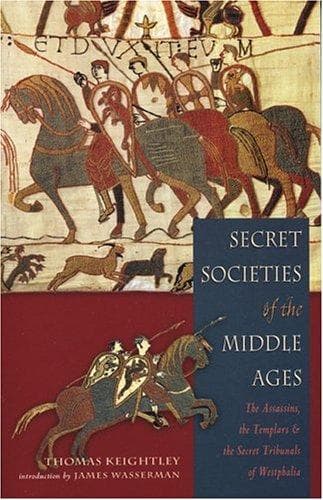
Secret Societies of the Middle AgesKeightley, Thomas
History
Secret Societies of the Middle Ages
Keightley, Thomas
Secret societies
It is not known what course Hans David now adopted; but nine years
afterwards (1441) we find him addressing himself to the Free-tribunal at
Freyenhagen, whose count, the notorious Mangolt, forthwith issued his
citations, "because, as he expressed himself, the order judges with the
sword and gentle murder and burning." The Grand Master, indignant at
this piece of arrogance, immediately brought the matter before the
assembly of the free-counts at Coblentz, who declared the proceedings
null, and Mangolt liable to punishment, as the knights were spiritual
persons. He moreover applied to the emperor, who, to gratify him, issued
a mandate, addressed to all princes of the empire, declaring the act of
Mangolt to be a piece of iniquity, and null and void.
Hans David was now cast into prison at Cologne, and, notwithstanding a
prohibition of the Free-tribunal, was detained there for two years.
Existing documents attest (though the fact is inexplicable) that the
emperor directed the Archbishop of Cologne and the Margraf of Baden to
examine anew into the affair, and to send the acts into the imperial
chancery, and, finally, to set the complainant free on his oath, or on
his giving bail to appear at Nuremberg. As this proceeding can only be
ascribed to the influence of the Secret Tribunals, bent on annoying the
order, it serves to show what their power and consequence must have been
at that time.
Two years afterwards it was clearly proved at Vienna that the bond had
been forged, at the desire of Hans David, by a scholar of Elbingen,
named Rothofé. As the case against the former was now so plain, it might
be supposed that he would be punished at once. Instead of that, the
emperor referred the parties to the pope, as Hans David had struck a
prior of the order, and this last was not content with the satisfaction
accorded by the emperor.
The cause of the order was triumphant in Rome also, yet still Hans David
found means to keep off the execution of the sentence already passed on
him at Vienna. It was not till after the death of the then Grand Master
that final judgment was formally delivered by Cardinal Jossi, and Hans
David, his comrade Paul Frankleuen, and the Count Mangolt, were
condemned to perpetual silence, and to payment of the sum of 6,000
Rhenish florins to the order, and, in case of disobedience, they were
declared to be outlawed. All this, however, did not yet avail, and two
years afterwards Jossi was obliged to apply to the emperor for the aid
of the temporal arm for the execution of the sentence. The chaplain of
the order at Vienna also found that Hans David had still the art to
deceive many and gain them over to his cause, and he accordingly took
care to have the whole account of his conduct posted up on the
church-doors.
Public-domain text, read in full here on John Shaqi.
Reviews
Reviews
No reviews yet
Be the first to share your thoughts on this work.
Elsewhere in the archive
Join the Discussion
Join the discussion
Sign in to leave a comment or review.
Sign InorCreate an account