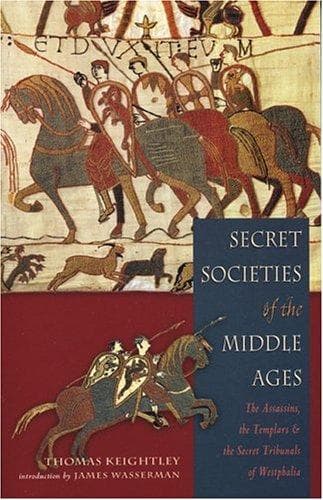
Secret Societies of the Middle AgesKeightley, Thomas
History
Secret Societies of the Middle Ages
Keightley, Thomas
Secret societies
A second cause was the opinion of these courts having been instituted by
Charles the Great, a monarch whose memory was held in such high
estimation and such just veneration during the middle ages. Emperors
thought themselves bound to treat with respect the institution of him
from whom they derived their authority; and the clergy themselves,
exempt from its jurisdiction, were disposed to view with favour an
institution established by the monarch to whom the Church was so deeply
indebted, and of whose objects the punishment of heretics was one of the
most prominent.
A third, and not the least important cause, was the excellent
organization of the society, which enabled it to give such effect to its
decrees, and to which nothing in those times presented any parallel. The
veil of secrecy which enveloped all its proceedings, and the number of
agents ready to execute its mandates, inspired awe; the strict inquiry
which was known to be made into the character of a man before he was
admitted into it gained it respect. Its sentences were, though the
proofs were unknown, believed to have emanated from justice; and bad men
trembled, and good men rejoiced, as they beheld the body of a criminal
suspended from a tree, and the schöppe's knife stuck beside it to
intimate by whom he had been judged and condemned.
The reign of the Emperor Maximilian was a period of great reform in
Germany, and his establishment of the Perpetual Public Peace, and of
the Imperial Chamber, joined with other measures, tended considerably to
alter and improve the condition of the empire. The Fehm-tribunals
should, as a matter of prudence, have endeavoured to accommodate
themselves to the new order of things; but this is a part of wisdom of
which societies and corporate bodies are rarely found capable; and,
instead of relaxing in their pretensions, they even sought to extend
them farther than before. Under their usual pretext--the denial of
justice--they extended their citations to persons and places over which
they had no jurisdiction, and thereby provoked the enmity and excited
the active hostility of cities and powerful territorial lords.
The most remarkable cases which this period presents of the perversion
of the rights and powers of the Fehm-tribunals are the two following:--
Public-domain text, read in full here on John Shaqi.
Reviews
Reviews
No reviews yet
Be the first to share your thoughts on this work.
Elsewhere in the archive
Join the Discussion
Join the discussion
Sign in to leave a comment or review.
Sign InorCreate an account