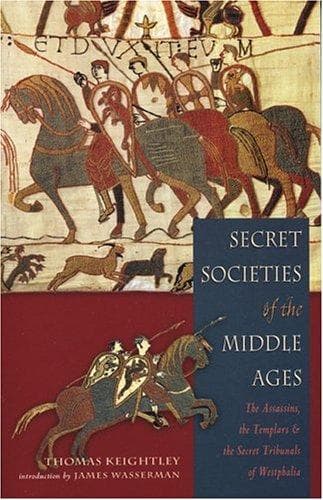
Secret Societies of the Middle AgesKeightley, Thomas
History
Secret Societies of the Middle Ages
Keightley, Thomas
Secret societies
Duke Ulrich of Würtemberg lived unhappily with his duchess Sabina. There
was at his court a young nobleman named Hans Hutten, a member of an
honourable and powerful family, to whose wife the duke was more
particular in his attentions than could be agreeable to a husband. The
duchess, on her side, testified a particular esteem for Hans Hutten, and
the intimacy between them was such as the duke could not forgive. Hutten
was either so vain or so inconsiderate as to wear publicly on his finger
a valuable ring which had been given to him by the duchess. This filled
up the measure of the jealousy and rage of the duke, and one day, at a
hunting-party in the wood of Bebling, he contrived to draw Hutten away
from the rest of the train, and, taking him at unawares, ran him through
with his sword; he then took off his girdle, and with it suspended him
from one of the oak-trees in the wood. When the murder was discovered he
did not deny it, but asserted that he was a free schöppe, and had
performed the deed in obedience to a mandate of the Secret Tribunal, to
which he was bound to yield obedience. This tale, however, did not
satisfy the family of Hutten, and they were as little content with the
proposal made by the murderer of giving them satisfaction before a
Westphalian tribunal. They loudly appealed to the emperor for justice,
and the masculine eloquence of Ulrich von Hutten interested the public
so strongly in their favour, that the emperor found himself obliged to
issue a sentence of outlawry against the Duke of Würtemberg. At length,
through the mediation of Cardinal Lang, an accommodation both with the
Hutten family and the duchess was effected; but the enmity of the former
was not appeased, and they some time afterwards lent their aid to effect
the deposition of the duke and the confiscation of his property.
It would seem that the Fehm-tribunals would have justified the
assassination committed by the duke, at least that all confidence in
their justice was now gone; and, at this period, even those writers who
are most lavish in their praises of the schöppen of the olden time can
find no language sufficiently strong to describe the iniquity of those
of their own days. It was now become a common saying that the course of
a Fehm-court was first to hang the accused and then to examine into the
charges against him. By a solemn recess of the Diet at Triers, in 1512,
it was declared "that by the Westphalian tribunals many an honest man
had lost his honour, body, life, and property;" and the Archbishop of
Cologne, who must have known them well, shortly afterwards asserted,
among other charges, in a capitulation which he issued, that "by very
many they were shunned and regarded as seminaries of villains."
The second case to which we alluded affords a still stronger proof of
their degeneracy.
Public-domain text, read in full here on John Shaqi.
Reviews
Reviews
No reviews yet
Be the first to share your thoughts on this work.
Elsewhere in the archive
Join the Discussion
Join the discussion
Sign in to leave a comment or review.
Sign InorCreate an account