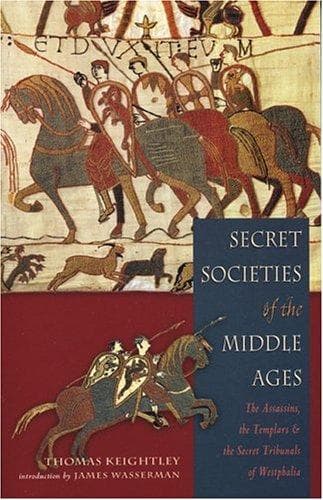
Secret Societies of the Middle AgesKeightley, Thomas
History
Secret Societies of the Middle Ages
Keightley, Thomas
Secret societies
Our readers will at once perceive how much the proceedings in this case,
which occurred in the year 1580, differed from those of former times.
Then the accused was formally summoned, and he was allowed to have an
advocate; here he was seized without knowing for what, and was hardly
granted even the formality of a trial. Then the people who came, even
accidentally, into the vicinity of a Fehm-court, would cross themselves
and hasten away from the place, happy to escape with their lives: now
they rush without apprehension to the spot where it was sitting, and the
members of it fly at their approach. Finally, in severity as well as
justice, the advantage was on the side of the old courts. The criminal
suffered by the halter; we hear of no father confessor being present to
console his last moments, and his body, instead of being deposited in
consecrated earth, was left to be torn by the wild beasts and ravenous
birds. The times were evidently altered!
[Illustration: Seal of the Secret Tribunals.]
The Fehm-tribunals were never formally abolished; but the excellent
civil institutions of the Emperors Maximilian and Charles V., the
consequent decrease of the turbulent and anarchic spirit, the
introduction of the Roman law, the spread of the Protestant religion,
and many other events of those times, conspired to give men an aversion
for what now appeared to be a barbarous jurisdiction and only suited to
such times as it was hoped and believed never could return. Some of the
courts were abolished; exemptions and privileges against them were
multiplied; they were prohibited all summary proceedings; their power
gradually sank into insignificance; and, though up to the present
century a shadow of them remained in some parts of Westphalia, they have
long been only a subject of antiquarian curiosity as one of the most
striking phenomena of the middle ages. They were only suited to a
particular state of society: while that existed they were a benefit to
the world; when it was gone they remained at variance with the state
which succeeded, became pernicious, were hated and despised, lost all
their influence and reputation, shared the fate of every thing human,
whose character is instability and decay, and have left only their
memorial behind them.
* * * * *
Public-domain text, read in full here on John Shaqi.
Reviews
Reviews
No reviews yet
Be the first to share your thoughts on this work.
Elsewhere in the archive
Join the Discussion
Join the discussion
Sign in to leave a comment or review.
Sign InorCreate an account