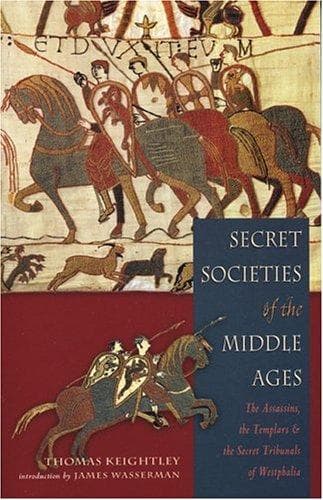
Secret Societies of the Middle AgesKeightley, Thomas
History
Secret Societies of the Middle Ages
Keightley, Thomas
Secret societies
Circumstances were now particularly favourable to the plans of Hassan
Sabah. On the death of sultan Malek Shah a civil war broke out among his
sons for the succession. All the military chiefs and persons of eminence
were engaged on one side or the other, and none had leisure or
inclination to attend to the progress of the Ismaïlites. These,
therefore, went on gradually extending their power, and fortress after
fortress fell into their hands. In the course of ten years they saw
themselves masters of the principal hill-forts of Persian Irak; they
held that of Shahdorr[27] (_King's pearl_), and two other fortresses,
close to Isfahan; that of Khalankhan, on the borders of Fars and
Kuhistan; Damaghan, Kirdkoo, and Firoozkoo, in the district of Komis;
and Lamseer and several others in Kuhistan. It was in vain that the most
distinguished imams and doctors of the law issued their _fetuas_ against
the sect of the Ismaïlites, and condemned them to future perdition; in
vain they called on the orthodox to employ the sword of justice in
freeing the earth from this godless and abominable race. The sect,
strong in its secret bond of unity and determination of purpose, went on
and prospered; the dagger avenged the fate of those who perished by the
sword, and, as the Orientalized European historian of the society
expresses it[28], "heads fell like an abundant harvest beneath the
twofold sickle of the sword of justice and the dagger of murder."
[Footnote 27: This castle was built by sultan Malek Shah. The following
was its origin:--As Malek Shah, who was a great lover of the chase, was
out one day a hunting, one of the hounds went astray on the nearly
inaccessible rock on which the castle was afterwards erected. The
ambassador of the Byzantine emperor, who was of the party, observed to
the sultan, that in his master's dominions so advantageous a situation
would not be left unoccupied, but would long since have been crowned
with a castle. The sultan followed the ambassador's advice, and erected
the castle of the King's Pearl on this lofty rock. When the castle fell
into the hands of the Ismaïlites, pious Moslems remarked that it could
not have better luck, since its site had been pointed out by a dog (an
unclean beast in their eyes), and its erection advised by an infidel.]
[Footnote 28: Hammer, 97.]
Public-domain text, read in full here on John Shaqi.
Reviews
Reviews
No reviews yet
Be the first to share your thoughts on this work.
Join the Discussion
Join the discussion
Sign in to leave a comment or review.
Sign InorCreate an account