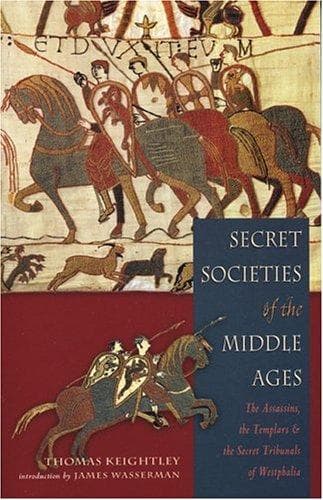
Secret Societies of the Middle AgesKeightley, Thomas
History
Secret Societies of the Middle Ages
Keightley, Thomas
Secret societies
acquisition of the castle of Banias, which the Ismaïlite governor put
into their hands, that under their protection he might escape the fate
of his brethren.
[Footnote 43: The number slain was 6,000.]
[Footnote 44: It was the month of December.]
Banias was given up to the Christians in the same year in which Alamoot
was taken by the Seljookian sultan, and thus the power of the Assassins
seemed to be almost gone. But it had in it a conservative principle,
and, hydra-like, it grew by its wounds. Alamoot was speedily recovered,
and three years afterwards Banias was once more the seat of a
Daï-al-Kebir. At the same time the dagger raged with unwonted fury
against all of whom the society stood in apprehension, and the annals of
the reign of Keäh Buzoorg Oomeid furnish a list of illustrious victims.
The first of these was the celebrated Aksunkur, Prince of Mossul, a
warrior equally dreaded by the Christians and by the Assassins. As this
prince, on his return from Maärra Mesrin, where the Moslem and Christian
hosts had parted without venturing to engage, entered the mosk at Mossul
to perform his devotions, he was attacked at the moment when he was
about to take his usual seat by eight assassins, disguised as dervishes.
Three of them fell beneath the blows of the valiant emir, but ere his
people could come to his aid he had received his death-wound and
expired. The remainder of the murderers became victims to the vengeance
of the people; one youth only escaped. The Arabian historian,
Kemal-ed-Deen, relates on this occasion a curious trait of the
fanaticism and Spartan spirit which animated the members of the sect of
the Ismaïlites. When the mother of the youth above-mentioned heard that
the formidable Aksunkur had been slain, she painted her face and put on
her gayest raiment and ornaments, rejoicing that her son had been found
worthy to die the glorious death of a martyr in the cause of the Imam.
But when she saw him return alive and unscathed, she cut off her hair
and blackened her countenance, and would not be comforted.
In the following year (1127) fell Moin-ed-deen, the vizir of Sultan
Sanjar. In this case the Assassin had engaged himself as a groom in the
service of the vizir. As Moin-ed-deen went one day into the stable to
look at his horses the Assassin appeared before him, stripped, and
holding one of the horses by the bridle. As the vizir, unsuspicious of
danger, came near where he was, the false groom made the horse rear,
and, under the pretence of soothing and pacifying the restive animal, he
took out a small dagger which he had concealed in the horse's mane, and
plunged it into the bosom of the vizir.
Public-domain text, read in full here on John Shaqi.
Reviews
Reviews
No reviews yet
Be the first to share your thoughts on this work.
Elsewhere in the archive
Join the Discussion
Join the discussion
Sign in to leave a comment or review.
Sign InorCreate an account